Plans for temporary facilities designed to house between 25,000 to 45,000 people have been revealed by Time Magazine. Sites in Alabama, Arizona, California,


Philip Elliott and W.J. Hennigan report:
The U.S. Navy is preparing plans to construct sprawling detention centers for tens of thousands of immigrants on remote bases in California, Alabama and Arizona, escalating the military’s task in implementing President Donald Trump’s “zero tolerance” policy for people caught crossing the Southern border, according to a copy of a draft memo obtained by TIME.
Phyllis L. Bayer, the assistant secretary of the Navy for energy, installations and environment for the Navy Secretary's approval. The memo anticipates a request from the Department of Homeland Security.
The memo includes details on the exact locations of the proposed detention centers. Detention centers would hold 25,000 immigrants at abandoned airfields "just outside the Florida panhandle near Mobile, Alabama, at Navy Outlying Field Wolf in Orange Beach, Alabama, and nearby Navy Outlying Field Silverhill."
"The memo also proposes a camp for as many as 47,000 people at former Naval Weapons Station Concord, near San Francisco; and another facility that could house as many as 47,000 people at Camp Pendleton, the Marines’ largest training facility located along the Southern California coast," according to the article. "The planning memo proposes further study of housing an undetermined number of migrants at the Marine Corps Air Station near Yuma, Arizona."
The plan expects to pay $233 million to build and operate the "temporary" facilities for six months. There are a few more key reported facts included in the article, including that these new facilities will be far from the first occasion for the United States to use military bases to house immigrants. "In 2014, the Obama Administration placed around 7,700 migrant children on bases in Texas, California and Oklahoma. The temporary shelters were shuttered after four months."
For commentary on the draft memo, see an article by Ed Kilgore that briefly discusses the potential reasons for building these facilities on military sites.
FULL STORY: Exclusive: Navy Document Shows Plan to Erect 'Austere' Detention Camps

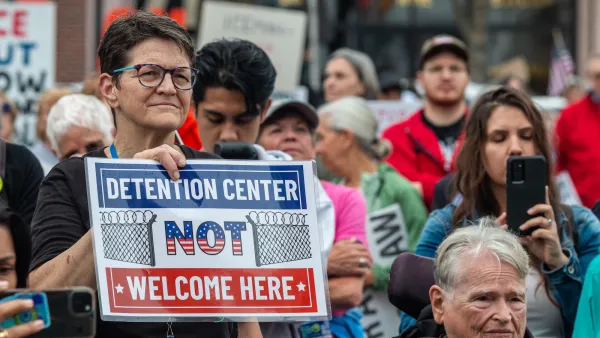
Land use as protest: How American cities are fighting federal immigration detention centers
Across the country, city officials are using zoning codes and land use law to limit where ICE detention facilities can be built.

Trump administration says DC height limits don't apply to federal projects
A federal commission cleared the way for the president's proposed 250-foot arch.

DOT withholds $73M from New York over immigrant trucking licenses
The Trump administration is requiring states to revoke the CDLs of non-domiciled drivers without proof of citizenship or risk losing federal funds.

Planetizen Federal Action Tracker
A weekly monitor of how Trump’s orders and actions are impacting planners and planning in America.

The state-sanctioned urbicide of Austin
People don’t kill cities. Freeways do.

US to reduce Colorado River water deliveries to Mexico
A new Colorado Treaty amendment reduces Mexico’s Colorado River water allocation by 250,000 acre feet.

5 New England states march closer to 800 megawatt wind energy project
Securing federal approval for the project may be complicated under the Trump administration, which has historically been hostile towards domestic wind power.

Baltimore to break ground on $50 million Transit Priority Project
The project will bring faster bus trips, safer streets and better bike connections to Baltimore.

Airbnb launches $250 million 'last-dollar financing' housing accelerator, makes first investment in Austin
The company will put $6.4 million towards affordable housing development in Texas’ capital.

FREE Course: Walkable City 1: Why Walkability?
After describing his path towards focusing on walkability as the essence of good planning, Jeff Speck marches through his five principal reasons for making more walkable places.
Reinventing Malls: Planning Alchemy—Turning Gray Fields Into Gold
The course focuses on the opportunities and imperatives that shape reinvention of mall sites.


Eagle County Government
Harvard University Graduate School of Design
Nashville Planning Department
The Architects Foundation
University of Cincinnati Online
The Pocatello Development Authority
The Urban Renewal Agency of the City of Pocatello
Journal of the American Planning Association