The winner of a competition to design the Chouteau Greenway in St. Louis hopes landscape architecture can inspire a larger conversation about race and class.


Zach Mortice reports in detail on plans for the Chouteau Greenway, under development by the Great Rivers Greenway, a regional public agency. The ambition of the project is undeniable:
The Chouteau Greenway (pronounced “show-toe”), which is planned to run about five miles from Forest Park on St. Louis’s western edge to the newly rejuvenated Gateway Arch National Park at the Mississippi River, is not a park. It’s not even a park system. It’s a landscape-driven development strategy for an entire swath of the city. Its goal is to break down the city’s stark north-south racial divide [pdf] by attracting St. Louisans from across a socioeconomic spectrum toward a corridor defined by a tangle of transit infrastructure. Along the way are some of the region’s most eminent education, medical, and cultural institutions.
The Great Rivers Greenway recently concluded a design competition, won by the Boston- and Los Angeles-based urban design firm Stoss. The Great Rivers Greenway "hopes to have a refined concept from Stoss by midsummer, though there is no money yet for implementation," reports Mortice. The article includes a lot more on the ambitions of the project as well as renderings and other visual materials included in the Stoss's winning submittal.
Read the full story: A “LOOP AND A STITCH” ACROSS ST. LOUIS’S DIVIDE

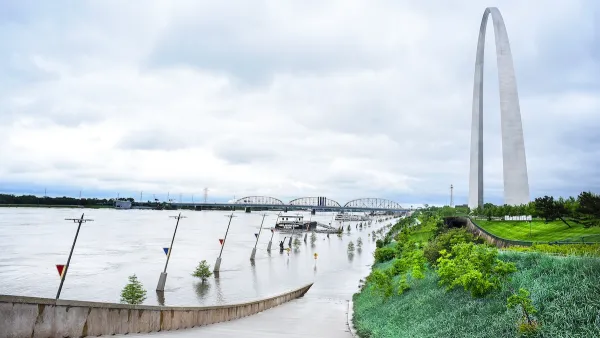
St. Louis has a Secret Stormwater Weapon Saving 100 Million Gallons from the Mississippi
The city reimburses residents who install gardens, rain barrels, and other methods that retain stormwater and decrease the risk of flooding.
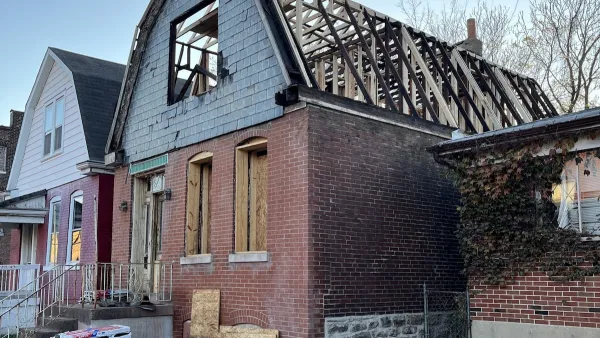
St. Louis Nonprofit Builds Housing for Struggling Artists
The St. Louis Art Place Initiative purchases city-owned vacant properties and rehabilitates them, offering homeownership opportunities to local artists.
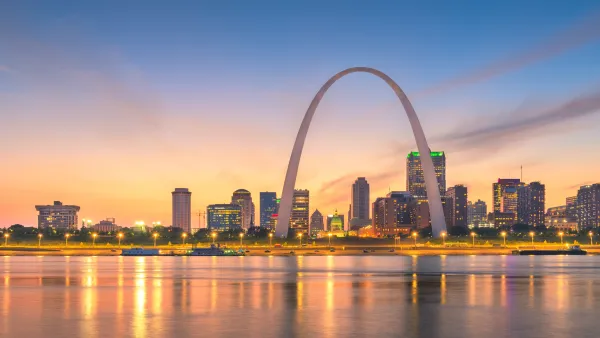
St. Louis Zeroing in on Safe Streets
The city is creating its first Department of Transportation and using hundreds of millions in federal funding to launch road safety projects.

Planetizen Federal Action Tracker
A weekly monitor of how Trump’s orders and actions are impacting planners and planning in America.

Amtrak, CN end decades-long dispute with eight-year agreement
The new operating agreement establishes an updated framework for the companies to work together, including processes to resolve disputes.

Judges permit Denver to divert 77,000 acre feet from the Colorado River for reservoir expansion
Overuse and climate change have caused the Colorado River’s water levels to plummet.

'Something we’ve never seen before:' rising utility rates could strain city finances nationwide
Data centers, climate change and other factors have caused utility rates in the United States to increase by 38% since 2020.

Trump to overrule local leaders, lease millions of acres of America’s Pacific Island territories’ seafloors to mining companies
International law says that the Indigenous people of America’s territories have a right to prior and informed consent regarding projects that impact their countries.

A ‘shady’ deal: Chicagoans rally against planned Amtrak maintenance facility
The $900 million facility would allow Amtrak to maintain entire trains in one building, which the company says will reduce delays.

FREE Course: Walkable City 1: Why Walkability?
After describing his path towards focusing on walkability as the essence of good planning, Jeff Speck marches through his five principal reasons for making more walkable places.
Reinventing Malls: Planning Alchemy—Turning Gray Fields Into Gold
The course focuses on the opportunities and imperatives that shape reinvention of mall sites.

KFH Group Inc.
Greater Baltimore Committee
Eagle County Government
The Architects Foundation
University of Cincinnati Online
The Pocatello Development Authority
The Urban Renewal Agency of the City of Pocatello