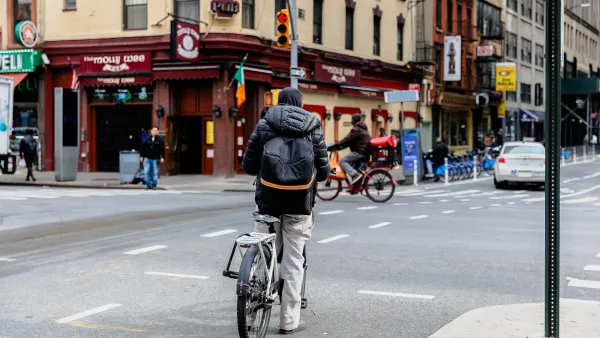
Allowing bikes on sidewalks pits cyclists against pedestrians, an advocate argues.



In the world of active transportation, "bike and pedestrian" is often uttered in one breath—as in "bike/ped," "ped/bike," "bike+ped," etc.
But for Douglas MacDonald, former Secretary of Transportation for the state of Washington, the two are not natural allies. Rather, in places without strong infrastructure for both—where neither walkers or cyclists can safely traverse car-dominated roads—they become adversaries competing for space on the sidewalk.
In Crosscut, MacDonald outlines how he sees this dynamic playing out in Seattle, where new state legislation allows e-bikes as well as regular bikes to be ridden on sidewalks. He argues that allowing any type of bike on the sidewalk is "a throwback to an earlier time," when cyclists were fewer and sidewalks were not recognized as "special refuge for the elderly or disabled." Not only do bikes in motion endanger pedestrians, he writes, but with the introduction of dockless bikeshare to the city, parked bikes are obstructing walking paths or encroaching on lawns.
On Planetizen, Ariel Godwin and Anne M. Price have dissected the implications of cycling on sidewalks, while Michael Lewyn has argued that pedestrians and cyclists should band together to fight for infrastructure that benefits both.
FULL STORY: E-bikers, these sidewalks are made for walking

NYC e-bike injury study highlights 'critical infrastructure deficiencies'
The sharp rise in e-mobility injuries points to a need for safer roads, not more punitive laws.

Pilot Project Offers E-Bike Rebates in New York State
The program will start in the Village of Ossining with plans to expand in the greater Hudson River region.

Taking on the Bad E-Bike Takes
How to spot a bad-faith e-bike story.

Planetizen Federal Action Tracker
A weekly monitor of how Trump’s orders and actions are impacting planners and planning in America.

The state-sanctioned urbicide of Austin
People don’t kill cities. Freeways do.

US to reduce Colorado River water deliveries to Mexico
A new Colorado Treaty amendment reduces Mexico’s Colorado River water allocation by 250,000 acre feet.

5 New England states march closer to 800 megawatt wind energy project
Securing federal approval for the project may be complicated under the Trump administration, which has historically been hostile towards domestic wind power.

Baltimore to break ground on $50 million Transit Priority Project
The project will bring faster bus trips, safer streets and better bike connections to Baltimore.

Airbnb launches $250 million 'last-dollar financing' housing accelerator, makes first investment in Austin
The company will put $6.4 million towards affordable housing development in Texas’ capital.

FREE Course: Walkable City 1: Why Walkability?
After describing his path towards focusing on walkability as the essence of good planning, Jeff Speck marches through his five principal reasons for making more walkable places.
Reinventing Malls: Planning Alchemy—Turning Gray Fields Into Gold
The course focuses on the opportunities and imperatives that shape reinvention of mall sites.

Eagle County Government
Harvard University Graduate School of Design
Nashville Planning Department
The Architects Foundation
University of Cincinnati Online
The Pocatello Development Authority
The Urban Renewal Agency of the City of Pocatello
Journal of the American Planning Association