The rollout of 5G, combined with the ability to compute on the edge, are allowing for new developments in V2V and V2I communications. Here's why low latency and gigabit speeds are essential.



A car moving at 50mph travels 72 feet—or 22 meters—in one second. If something happens on the road, and the vehicle's network sends a message to the brakes that takes 100 milliseconds to arrive, it could be too late to stop a collision. Any delay could be critical.
Today's wireless networks have run into a problem—more people and devices are consuming more data than ever before, but data remains crammed on the same bands of the radio-frequency spectrum that mobile providers have always used. Those bands, from 300KHz to 6GHz, are used for everything: smartphones, fixed wireless phones, remote control devices, all WiFi 801.11 specs, Bluetooth and other devices.
Having gigabit speeds and low latency, down to one millisecond, is not enough to ensure quick response, especially on self-driving vehicles. Fast on-board CPUs, plus additional processing at basestations, is a must. This is commonly referred to as edge computing.
Read the full story: 5G & Edge Computing: Enabling Autonomous Vehicles

Battle of Technologies Shaping-Up for Connected Vehicles
The U.S. Department of Transportation proposed a new rule on Dec. 13 for automakers to require vehicle-to-vehicle technology to save lives, but critics charge the radio-based technology will be obsolete when the rule takes effect in about seven years
New USDOT safety strategy highlights enforcement, embraces autonomous cars
The new National Roadway Safety Strategy emphasizes safety technology and enforcement and promises to further crack down on immigrant truck drivers with illicitly obtained licenses.
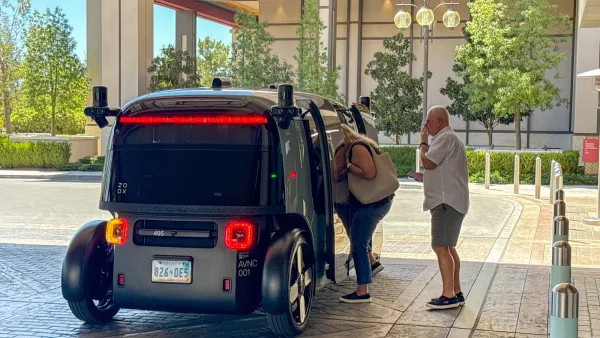
Amazon's Zoox recalls robotaxis after failure to recognize active fire scene
The car did not register the thick smoke as it drove into a fire scene.

Planetizen Federal Action Tracker
A weekly monitor of how Trump’s orders and actions are impacting planners and planning in America.

Amtrak, CN end decades-long dispute with eight-year agreement
The new operating agreement establishes an updated framework for the companies to work together, including processes to resolve disputes.

Northwest rail fans eager for Sept. 30 debut of Amtrak’s Airo fleet
Get ready for that new train smell and more seats. But they won’t go faster or run more frequently on the Cascades route in Washington and Oregon.

St. Louis Metro to test if single-car trains can reduce operating costs, maintain rider satisfaction
The pilot program will run from October to spring 2027, and begin with one single-car train operating on Metrolink’s Red and Blue lines.

Pennsylvania is building data centers in abandoned mines
Housing data centers in mines provides an alternative to destroying local forests and may spare residents from data centers’ noise and air pollution.

If Corpus Christi can’t revive desalination plant project, it may owe Texas $235 million
Earlier this month, city officials declined to pursue developing the plant for the second time in a year.

FREE Course: Walkable City 1: Why Walkability?
After describing his path towards focusing on walkability as the essence of good planning, Jeff Speck marches through his five principal reasons for making more walkable places.
Reinventing Malls: Planning Alchemy—Turning Gray Fields Into Gold
The course focuses on the opportunities and imperatives that shape reinvention of mall sites.

City of Thousand Oaks
City of Wisconsin Rapids
Harvard University Graduate School of Design
The Architects Foundation
University of Cincinnati Online
The Pocatello Development Authority
The Urban Renewal Agency of the City of Pocatello