Raise your hand if you envisioned a transportation network optimized to full efficiency by navigation apps.


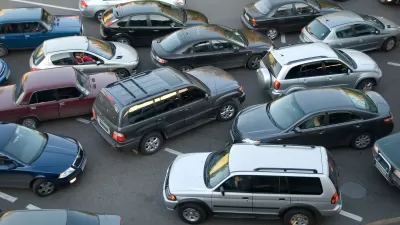
Navigation apps are allowing people to make more selfish decisions while driving, spreading traffic and congestion more evenly throughout the grid. Alexis C. Madrigal's explanation of this troubling outcome of navigation apps like Waze commences with a discussion of selfishness.
In the pre-mobile-app days, drivers’ selfishness was limited by their knowledge of the road network. In those conditions, both simulation and real-world experience showed that most people stuck to the freeways and arterial roads. Sure, there were always people who knew the crazy, back-road route, but the bulk of people just stuck to the routes that transportation planners had designated as the preferred way to get from A to B.
Now, however, a new information layer is destroying the nudging infrastructure that traffic planners built into cities. Commuters armed with mobile mapping apps, route-following Lyft and Uber drivers, and software-optimized truckers can all act with a more perfect selfishness.
A new study by researchers at UC Berkeley’s Institute of Transportation Studies inspires this discussion of a "vastly overlooked" problem. Here's Madrigal's summary of the findings of that study: "In some scenarios, traffic-beating apps might work for an individual, but make congestion worse overall. And autonomous vehicles, touted as an answer to traffic-y streets, could deepen the problem."
Alexandre Bayen, director of UC Berkeley’s Institute of Transportation Studies, is also on video discussing the study's findings, and more about what navigation apps mean for the future of traffic and congestion in cities.
FULL STORY: The Perfect Selfishness of Mapping Apps

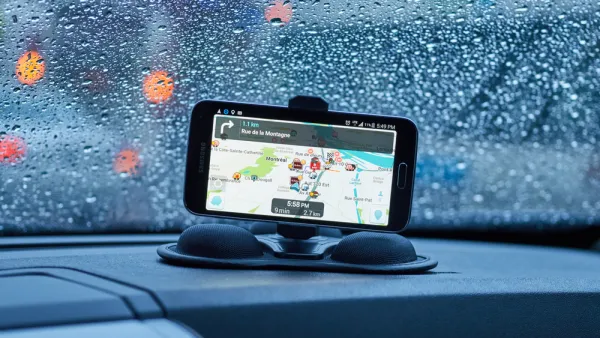
Are Traffic Apps More a Problem Than a Solution?
The companies behind navigation apps say they want to decrease congestion in cities. But a tool that is essentially designed to help individuals isn’t going to provide a collective benefit.
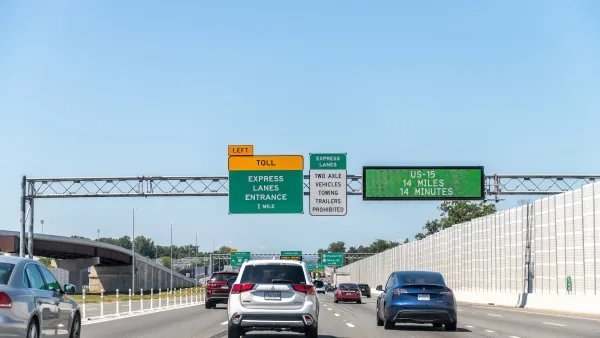
Congestion Costing Reality Check, Part 2: A congestion costing critique
There are good reasons to be skeptical of highway industry claims that traffic congestion is a growing problem. Their analysis is often incomplete and biased. Let’s pull back the curtain on some major congestion cost studies.
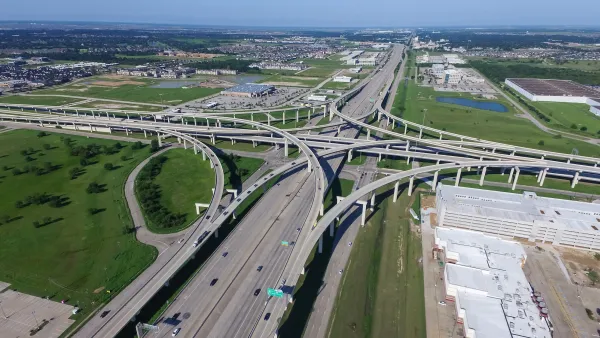
Induced demand is real: Commutes on Houston's 26-lane freeway take 51% longer after expansion
A massive freeway expansion only led to longer drive times, showing that building more lanes won't solve congestion.

Planetizen Federal Action Tracker
A weekly monitor of how Trump’s orders and actions are impacting planners and planning in America.

The state-sanctioned urbicide of Austin
People don’t kill cities. Freeways do.

US to reduce Colorado River water deliveries to Mexico
A new Colorado Treaty amendment reduces Mexico’s Colorado River water allocation by 250,000 acre feet.

5 New England states march closer to 800 megawatt wind energy project
Securing federal approval for the project may be complicated under the Trump administration, which has historically been hostile towards domestic wind power.

Baltimore to break ground on $50 million Transit Priority Project
The project will bring faster bus trips, safer streets and better bike connections to Baltimore.

Airbnb launches $250 million 'last-dollar financing' housing accelerator, makes first investment in Austin
The company will put $6.4 million towards affordable housing development in Texas’ capital.

FREE Course: Walkable City 1: Why Walkability?
After describing his path towards focusing on walkability as the essence of good planning, Jeff Speck marches through his five principal reasons for making more walkable places.
Reinventing Malls: Planning Alchemy—Turning Gray Fields Into Gold
The course focuses on the opportunities and imperatives that shape reinvention of mall sites.

Eagle County Government
Harvard University Graduate School of Design
Nashville Planning Department
The Architects Foundation
University of Cincinnati Online
The Pocatello Development Authority
The Urban Renewal Agency of the City of Pocatello
Journal of the American Planning Association