As the Portland City Council considers the Central City 2035 plan, downtown residents, many of whom live in high-rises, are actively opposing regulations that would allow new high-rises.


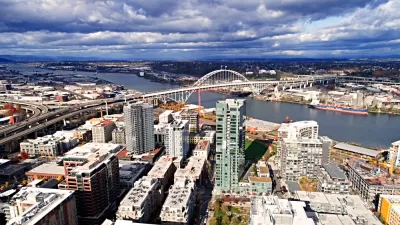
Rachel Monahan reports on the "skyscraper backlash" emerging in Portland. The controversy centers around a proposal for a 17-story glass and concrete tower in the Pearl District called the Fremont Place Apartments. The leading opponents of the skyscraper: residents of a nearby 28-story skyscraper called the Cosmopolitan.
The opposition actions have been lead by the Pearl District Neighborhood Association, which has gained support for residents of other high-rises in the neighborhood. Monhan quotes residents of high-rises blaming plans for new high-rises with "losing our Oregon soul" and "sacrificing the integrity" of the city.
Added to all this irony and controversy, the Portland City Council is expected to set height limits in the Central City 2035 plan, with consequences beyond the Pearl District in and around downtown Portland. Planners have recommended a height limit of 250 feet. "Citizens are begging commissioners to amend the planners' proposals so that current views are preserved," according to Monahan.
Monahan concludes the article by presenting a counter argument that supports a supply-side approach to improving the city's housing shortage.

Portland 2035 Comprehensive Plan Clears Legal Hurdle
The portion of Portland's Comprehensive Plan devoted to missing middle housing spurred a lawsuit that held up the plan until January of this year.

Portland: Homes for Everyone, or Not in My Neighborhood
Even progressive Portland wrestles with conservatism when it comes to housing in single-family neighborhoods
Multi-Family Development in Portland Stalls at a Controversial Crossroads for the City
On the one hand, the city of Portland is facing pressure to add new housing and development to meet the needs of a growing population and an expensive real estate market. On the other hand, change is never easy.

The state-sanctioned urbicide of Austin
People don’t kill cities. Freeways do.

US to reduce Colorado River water deliveries to Mexico
A new Colorado Treaty amendment reduces Mexico’s Colorado River water allocation by 250,000 acre feet.

New Jersey’s second-largest city bans standalone data centers
Jersey City will continue to allow co-location facilities, such as those meant for research institutions that store their own data.

Amtrak not solely to blame for New Jersey commuter rail's unreliability, report finds
A new study from the Garden State Initiative found that NJ Transit’s budget grew 20% across a 4 year period, but reliability declined significantly over the same period.

EPA erases limits on planet-warming pollution from power plants
Under Monday’s plan, power plants would still have some limits on how much mercury, arsenic and other contaminants they can emit.

Phoenix announces new on-demand transit service, more frequent RAPID buses
Both new services will launch in October, and are part of Phoenix's Project Effective Access Solutions for Easing Congestion.

FREE Course: Walkable City 1: Why Walkability?
After describing his path towards focusing on walkability as the essence of good planning, Jeff Speck marches through his five principal reasons for making more walkable places.
Reinventing Malls: Planning Alchemy—Turning Gray Fields Into Gold
The course focuses on the opportunities and imperatives that shape reinvention of mall sites.

Eagle County Government
Harvard University Graduate School of Design
Nashville Planning Department
The Architects Foundation
University of Cincinnati Online
The Pocatello Development Authority
The Urban Renewal Agency of the City of Pocatello
Journal of the American Planning Association