The largest private landlord in the U.S. faces a discrimination suit for refusing to rent to people with criminal records.



Civil rights nonprofit Equal Rights Center has sued Mid-America Apartments, which holds more than 100,000 apartments across the U.S., over its policy of rejecting rental applicants with convictions or pending charges.
The lawsuit rests on whether this policy violates the Fair Housing Act by virtue of its disparate impact on Black and Latino populations, who are overrepresented in the criminal punishment system. That conclusion is supported by guidelines issued by HUD in 2016 under the Obama administration.
Several U.S. cities, including Seattle and D.C., have considered adopting "ban the box" policies—usually applied to hiring and employment practices—for housing applications. That approach can deter discrimination and expand access to housing as well as yielding wider social benefits, according to the Center:
“The ability of people who come out of prison and jail to maintain stable housing has a huge impact on recidivism rates,” said Kate Scott, deputy director of the Equal Rights Center. “To say that a person with a criminal record can’t have housing is going to lead to a lot of other social problems.”
FULL STORY: America’s largest private landlord faces civil rights lawsuit


HUD Plans to Kill Key Fair Housing Rule
The department issued a proposal to eliminate the disparate impact rule, a cornerstone of some discrimination rulings under the Fair Housing Act.

Trump Administration Launches Long-Promised Challenge to Fair Housing Law
A new rule proposed by the U.S. Department of Housing and Urban Development raises the burden of proof in cases of disparate impact, and provides additional defenses for defendants.
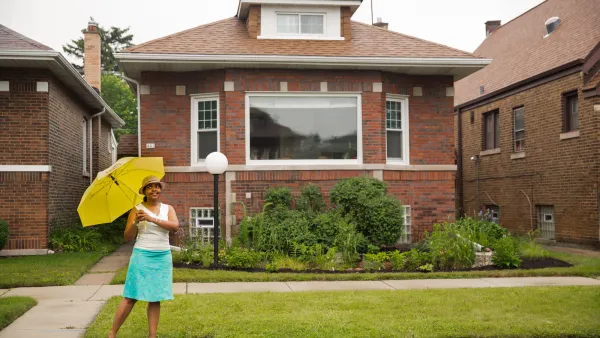
The Numerous Obstacles—Past and Present—Facing Black Homeowners
Black Americans pay a higher price to be homeowners—and the number of those who can afford to pay that price is dropping quickly.

Planetizen Federal Action Tracker
A weekly monitor of how Trump’s orders and actions are impacting planners and planning in America.

The state-sanctioned urbicide of Austin
People don’t kill cities. Freeways do.

US to reduce Colorado River water deliveries to Mexico
A new Colorado Treaty amendment reduces Mexico’s Colorado River water allocation by 250,000 acre feet.

5 New England states march closer to 800 megawatt wind energy project
Securing federal approval for the project may be complicated under the Trump administration, which has historically been hostile towards domestic wind power.

Baltimore to break ground on $50 million Transit Priority Project
The project will bring faster bus trips, safer streets and better bike connections to Baltimore.

Airbnb launches $250 million 'last-dollar financing' housing accelerator, makes first investment in Austin
The company will put $6.4 million towards affordable housing development in Texas’ capital.

FREE Course: Walkable City 1: Why Walkability?
After describing his path towards focusing on walkability as the essence of good planning, Jeff Speck marches through his five principal reasons for making more walkable places.
Reinventing Malls: Planning Alchemy—Turning Gray Fields Into Gold
The course focuses on the opportunities and imperatives that shape reinvention of mall sites.

Eagle County Government
Harvard University Graduate School of Design
Nashville Planning Department
The Architects Foundation
University of Cincinnati Online
The Pocatello Development Authority
The Urban Renewal Agency of the City of Pocatello
Journal of the American Planning Association