A new Harvard study reports that the rental market began to decline this year, and may continue to drop as higher income renters become homeowners. However, the report was released a week before the GOP tax cuts bill was signed.


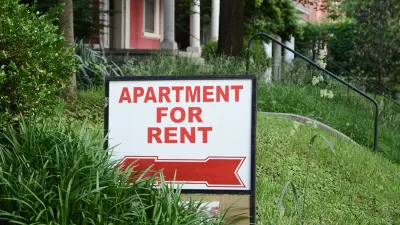
"According to a new report from the Harvard Joint Center for Housing Studies, the number and share of Americans who rent their homes have appeared to decline in 2017 for the first time since 2004," a 12-year stretch, reports Henry Grabar of Slate via Business Insider on Dec. 23. [See Planetizen post on the report.]
It’s hard to appreciate the scale of that decade-plus surge, which began in 2004, jumped as homeownership struggled during the foreclosure crisis, and didn’t slow down as a lack of new construction during and after the recession helped housing markets recover more quickly than wages. The homeownership rate hit a 50-year low in 2016 [62.9 percent, after peaking in 2004 at 69.2 percent].
"The impact of 10 million new tenant households in the last 10 years" has been felt the most on low-income renters, adds Grabar, because "about 60 percent of the growth in rental households since 2006 has occurred in households making more than $50,000," according to the report. While that's below the real median household income of $59,039 in 2016, renter income is significantly lower.
"The median income for rent-occupied households was $31,888" in 2012, according to the National Association of Home Builders. "The median income for owner-occupied households was more than twice that amount at $65,514."
"While rents have abated slightly in the past two years, nearly half of rental households pay more than 30 percent of their income in rent, and the rate is much higher in high-cost states and the nation’s largest cities," adds Grabar. That's why he calls the 12-year rental market surge a "high-income phenomenon."
In short: The foreclosure crisis dumped a lot of high earners who have traditionally bought homes into the rental market. Rapidly rebounding housing markets, with skyrocketing home prices in big cities, kept them there. Now the number of renters has reached a plateau.
==================================================================================================================
A week after the Harvard housing report was released, President Trump signed H.R. 1, the Tax Cuts and Jobs Act, which has the potential to throw a wrench into the housing and rental markets. With a reduction in the mortgage interest deduction, capping state, local, and property tax deductions at $10,000, and doubling the standard deduction which will reduce the number of filers who itemize their taxes, the incentive to purchase homes may be seriously curtailed,
On the other hand, the tax changes will also reduce home prices "[f]or roughly 80% of counties in the country," according to Moody's Analytics, reports The Wall Street Journal's housing correspondent, Laura Kusisto, on Dec. 24.
Should the tax bill reverse the recent downward trend in the rental market, bringing no relief for current renters, there is still a silver lining, remarks Grabar. It "could push to reshape a local and national political structure that has long favored homeownership as not only an economic goal but the mark of a good citizen."
And that change, ultimately, might be even better.
Hat tip to Peter Flieg.
Read the full story: America's great renter boom is over


On to a New Era of Rental Housing
A decade after an epochal shift in the housing market, the country is changing again.
As Luxury Rents Drop, Low-Income Tenants Pay More
With increasing pressure on the nation's supply of affordable housing, low- and middle-income renters are seeing their rents go up while higher-quality apartments drop prices to lure back remote workers.

Home Ownership Subsidy Takes a $250,000 Hit in Final Version of Tax Bill
The current mortgage interest deduction is $1 million. The House version of the tax bill called for a $500,000 cap while the Senate left it untouched. They split the difference and capped it at $750,000. Congress is expected to pass H.R. 1 this week

Planetizen Federal Action Tracker
A weekly monitor of how Trump’s orders and actions are impacting planners and planning in America.

Colorado’s Largest Data Center Could Rise Next to Homes — Without a Public Hearing
The proposed campus would consume 11 times the power of Denver International Airport; as it has across the country, opposition mounts.

US to reduce Colorado River water deliveries to Mexico
A new Colorado Treaty amendment reduces Mexico’s Colorado River water allocation by 250,000 acre feet.

'This is going to be painful:’ Virginia stares down $1.7 billion funding gap for highway maintenance
The state may address the deficit by shifting $290 million from its construction budget to maintenance projects.

Judges permit Denver to divert 77,000 acre feet from the Colorado River for reservoir expansion
Overuse and climate change have caused the Colorado River’s water levels to plummet.

Amtrak, CN end decades-long dispute with eight-year agreement
The new operating agreement establishes an updated framework for the companies to work together, including processes to resolve disputes.

FREE Course: Walkable City 1: Why Walkability?
After describing his path towards focusing on walkability as the essence of good planning, Jeff Speck marches through his five principal reasons for making more walkable places.
Reinventing Malls: Planning Alchemy—Turning Gray Fields Into Gold
The course focuses on the opportunities and imperatives that shape reinvention of mall sites.

KFH Group Inc.
Greater Baltimore Committee
Eagle County Government
The Architects Foundation
University of Cincinnati Online
The Pocatello Development Authority
The Urban Renewal Agency of the City of Pocatello