There is hope that affordable housing advocates will agree that adding supply at any price point can help provide affordable housing as a result.



Joe Cortright at City Observatory argues that recent studies should change the debate over affordable housing, saying that increasing housing supply at all price points helps. Even building more market rate housing reduces displacement.
The Sightline Institute reasons that the only way to solve the affordable housing crisis and related displacement is to build our way out of it. While building more market rate housing frees up affordable units ("trickle-down"), a Shelterforce article argues that the most impactful thing to do is to build more low- and moderate income housing.
"The same policies that facilitate market rate housing–more density, fewer parking requirements, clear and certain approval processes–would also make it less expensive to build affordable housing."
So, while building more affordable housing has the most impact, it is also the most expensive option. There are many ways to address the affordable housing crisis, and adding units at any price point helps.
Read the full story: The End of the Housing Supply Debate (Maybe)

San Francisco Mayor’s ‘Family Zoning’ Plan Faces Pushback, Displacement Concerns
Newly proposed legislation aims to protect long-term tenants from displacement caused by Mayor Lurie’s proposed zoning reform plan, which would allow for more housing construction in parts of the city.
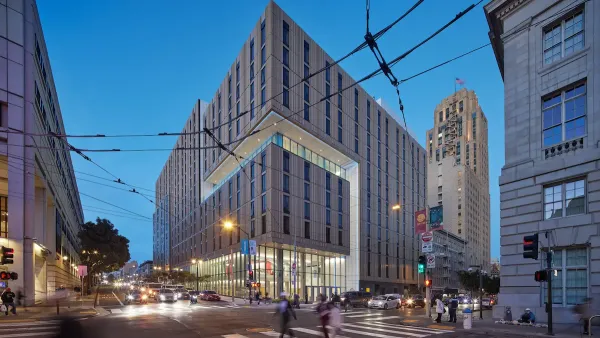
A San Francisco University Just Built Over 650 Affordable Units. Are Institutions the Answer to the Housing Crisis?
With access to planning resources not always available to private developers, universities are uniquely positioned to build housing quickly and cost-effectively.

20,000 San Francisco Homes Stalled in Construction Pipeline
Despite getting permits as long as a decade ago, thousands of proposed housing units are still waiting to be built.

Planetizen Federal Action Tracker
A weekly monitor of how Trump’s orders and actions are impacting planners and planning in America.

California plans to bury El Niño’s downpour
If the state plays its cards right, it may be able to store a billion acre-feet of El Niño’s water in aquifers.

Desperate measures: Advocates weigh draining Lake Powell to fill Colorado River
Draining the reservoir could reduce evaporation losses by a couple hundred thousand acre-feet.

Eastern Nebraska is running out of electricity
Data centers and electrification are straining eastern Nebraska’s grid, throttling economic development.

Seattle passes record-breaking transit services expansion
Proposition 1 will double the city’s transit tax to add 95,000 more bus trips and preserve 180,000 bus trips annually.

Post election, Texas is no longer Musk’s 'AI oasis'
Elon Musk dolled out $446 million on the 2026 midterms, the most ever spent by a non-canidate.

FREE Course: Walkable City 1: Why Walkability?
After describing his path towards focusing on walkability as the essence of good planning, Jeff Speck marches through his five principal reasons for making more walkable places.
Reinventing Malls: Planning Alchemy—Turning Gray Fields Into Gold
The course focuses on the opportunities and imperatives that shape reinvention of mall sites.

City of Rosemead
Rutgers University, Edward J. Bloustein School of Planning and Public Policy
One Hundred Miles
Hunter College, City University of New York (CUNY)
The Architects Foundation
University of Cincinnati Online
City of Cambridge
Montrose County
The Pocatello Development Authority