The speculation about a planned transit investment program in Nashville began in August, and now the mayor is throwing full support behind a referendum that would raise four kinds of taxes to pay for a $5.2 billion in transit investments.


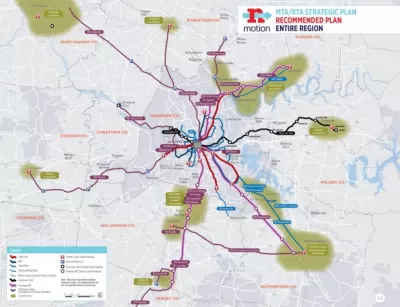
Nashville Mayor Megan Barry this week "unveiled a monumental proposal for a $5.2 billion mass transit system, the most expensive, far-reaching and complicated project in Metro history," reports Joey Garrison.
Planetizen last caught wind of this ambitious transit infrastructure investment package in August, after the Nashville Metro Transit Authority released a "High Capacity Transit Briefing Book" [pdf] to map out the prospective system. Now Mayor Barry is pushing for a May referendum "to approve via referendum raising four taxes to pay for the massive undertaking," according to Garrison. "Leading the way as a revenue generator would be a one-half percent hike to the sales tax that would jump to 1 percent in 2023. [The mayor has] also proposed increases to the city’s hotel-motel tax, rental car tax and business and excise tax."
Read the full story: Mayor Barry unveils sweeping $5.2 billion transit proposal for Nashville with light rail, massive tunnel

Five Corridors of High Capacity Transit Coming to Nashville
A 25-year regional transit plan, which includes five corridors for light rail or bus rapid transit lines, is taking shape in Nashville,
Nashville Could Be a National Example for Transit—If They Don't Screw Up
Nashville Mayor Megan Barry resigned from office earlier this month. The question now becomes whether an ambitious transit investment plan she supported can survive her exit.
'Better Bus' Is Nashville's Latest Attempt at Transit Upgrades
The Better Bus plan is the latest effort at rethinking public transit in Nashville.

Planetizen Federal Action Tracker
A weekly monitor of how Trump’s orders and actions are impacting planners and planning in America.

California plans to bury El Niño’s downpour
If the state plays its cards right, it may be able to store a billion acre-feet of El Niño’s water in aquifers.

Chicago breaks ground on $3 billion megadevelopment
The new neighborhood, titled Foundry Park, will one day host 3,700 residences.

Satanic Place Names
From streams and lakes to valleys and canyons, I mapped more than 1,000 places named after the Devil.

California High-Speed Rail Authority CEO resigns after $600,000 scandal
Under Ian Choudri, the authority used taxpayer dollars to fund first class flights and trips to nightclubs.

Want to study the Missouri River? Soon, you may need unanimous approval from 10 states
Legislation would require 10 governors’ permission to study or build projects moving water outside the basin.

FREE Course: Walkable City 1: Why Walkability?
After describing his path towards focusing on walkability as the essence of good planning, Jeff Speck marches through his five principal reasons for making more walkable places.
Reinventing Malls: Planning Alchemy—Turning Gray Fields Into Gold
The course focuses on the opportunities and imperatives that shape reinvention of mall sites.

City of Rosemead
Rutgers University, Edward J. Bloustein School of Planning and Public Policy
One Hundred Miles
Hunter College, City University of New York (CUNY)
The Architects Foundation
University of Cincinnati Online
City of Cambridge
Montrose County
The Pocatello Development Authority