Not only did Hurricane Maria destroy most of Puerto Rico's man-made infrastructure, it also defoliated the island's vast tropical forests, upsetting the forest ecology—in the short term.


"One of the most dramatic sights left by Hurricane Maria is the denuding of Puerto Rico," states NPR's John Burnett in his report (available on audio) on Puerto Rico's forest ecology. "The lush forests for which this island is famous were stripped bare by the cyclone."
Fortunately, the destruction to the forests is one of defoliation, not deforestation. The foliage will return, though, just like it did after the category 3 Hurricane Hugo devastated part of the island in September 1989.
Like the destroyed electric grid and other crucial infrastructure that will be rebuilt with help from the Army Corps of Engineers that serve the 3.4 million residents of this Caribbean island, though, it will take time, and in the near term, be disruptive, particularly to the forest's fauna. But the results are worth the wait, according to scientists who have "been studying the same forests ....since 1943," states Burnett.
Through an accident of weather and geography, Puerto Rico has perhaps the best research on the interaction between hurricanes and tropical forests in the Western Hemisphere.
"The forest is impatient to reinvent itself"
What Dr. Ariel Lugo, the 74-year-old director of the International Institute of Tropical Forestry, part of the U.S. Department of Agriculture's Forest Service and other scientists learned after Hugo defoliated the hills "is that regrowth here was two to three times as robust and productive as a normal healthy forest."
The trees race upward to regain their choice positions in the canopy and photosynthesize the sunlight. The tallest are the victors.
It took the forest three to four years to recover after Hugo, and it probably will for Maria, too.
Burnett asks Lugo what he has to say to residents who are anxious to see the island become green again.
"Unfortunately, it's the same thing they are being told when they are waiting for gas, food and water," Lugo replies. "Be patient."
FULL STORY: After Hurricane's Wrath, Puerto Rico's Green Forests Turn Bare Brown

US Forest Service Could Open Millions of Roadless Acres to Logging
The USDA indicated it plans to repeal the ‘Roadless Rule,’ a Clinton-era regulation that prevents new road-building in undeveloped federal forest areas.
What Forest Service Cuts Mean for Cities
U.S. Forest Service employees work on projects that have impacts far beyond remote, rural wilderness areas.
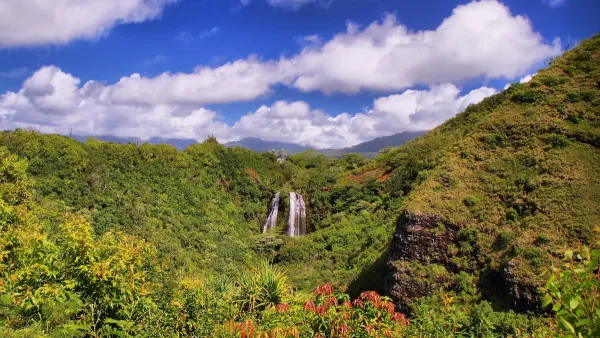
How Protecting Kauaʻi’s Forests Safeguards Fresh Water
A University of Hawaiʻi study shows that protecting Kauaʻi’s native forests from invasive species significantly boosts groundwater recharge, making it a cost-effective strategy to secure fresh water and enhance climate resilience.

Planetizen Federal Action Tracker
A weekly monitor of how Trump’s orders and actions are impacting planners and planning in America.

The state-sanctioned urbicide of Austin
People don’t kill cities. Freeways do.

US to reduce Colorado River water deliveries to Mexico
A new Colorado Treaty amendment reduces Mexico’s Colorado River water allocation by 250,000 acre feet.

5 New England states march closer to 800 megawatt wind energy project
Securing federal approval for the project may be complicated under the Trump administration, which has historically been hostile towards domestic wind power.

Baltimore to break ground on $50 million Transit Priority Project
The project will bring faster bus trips, safer streets and better bike connections to Baltimore.

Airbnb launches $250 million 'last-dollar financing' housing accelerator, makes first investment in Austin
The company will put $6.4 million towards affordable housing development in Texas’ capital.

FREE Course: Walkable City 1: Why Walkability?
After describing his path towards focusing on walkability as the essence of good planning, Jeff Speck marches through his five principal reasons for making more walkable places.
Reinventing Malls: Planning Alchemy—Turning Gray Fields Into Gold
The course focuses on the opportunities and imperatives that shape reinvention of mall sites.

Eagle County Government
Harvard University Graduate School of Design
Nashville Planning Department
The Architects Foundation
University of Cincinnati Online
The Pocatello Development Authority
The Urban Renewal Agency of the City of Pocatello
Journal of the American Planning Association