Governor Larry Hogan's $9 Billion Highway Plan Critiqued


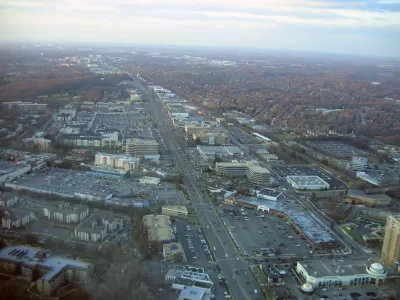
Angie Schmitt writes a scathing critique of the transportation infrastructure investments proposed by the administration of Maryland Governor Larry Hogan.
Here, Schmitt sums up the situation:
A Republican elected in a blue state, Hogan said Maryland just couldn’t afford the Baltimore Red Line, a 14-mile light rail route that would have connected low-income, predominantly black neighborhoods to downtown jobs. When he unilaterally decided to kill the $2.9 billion project in 2015, Hogan called it a “wasteful boondoggle.” The decision prompted a civil rights complaint by the national NAACP on the basis that it was racially discriminatory.
Well — surprise, surprise — it turns out when a multi-billion transportation project that doesn’t benefit black city residents catches his eye, Hogan is fine with opening up the spigots.
Schmitt goes on to critique some of Hogan's talking points in support of the plan, including the cost effectiveness of using tolls and the appeal of the investment in attracting the eye of Amazon, which is famously looking for a location for a second headquarters.
For a news report on Hogan's $9 billion highway widening plan, see an article by Erin Cox. In that article, Hogan is presented making the case that the widened freeways will improve quality of life for Maryland residents.
Read the full story: Maryland Governor Larry Hogan’s Bogus Fiscal Conservatism Doesn’t Apply to Highways

Key Planning Agency Rejects Maryland Highway Widening Proposal
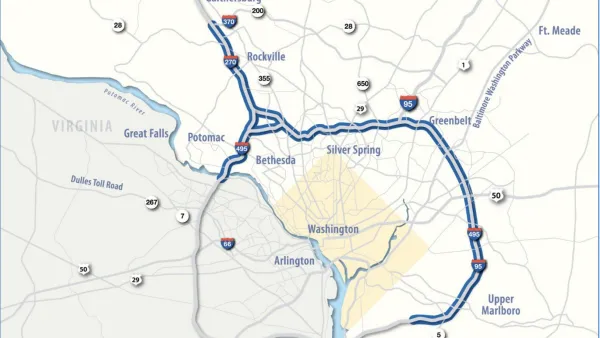
A plan to widen interstates 495 and 270 failed a critical step on the way to approval, in a decision likely to lead to a lawsuit when the Maryland Department of Transportation settles on a final plan.
Big Highway Widening Plan Faces Public Scrutiny in Maryland
First proposed in 2019, Maryland Gov. Larry Hogan's highway widening plan has been trimmed everywhere but the bottom line.
Maryland Highway Widening Plans Moving Forward Under New Governor
Maryland Governor Wes Moore is differentiating his new administration from his predecessor’s, but some projects, like the widening of federal highways in the Capital Beltway, stay the same.

Planetizen Federal Action Tracker
A weekly monitor of how Trump’s orders and actions are impacting planners and planning in America.

Amtrak, CN end decades-long dispute with eight-year agreement
The new operating agreement establishes an updated framework for the companies to work together, including processes to resolve disputes.

Judges permit Denver to divert 77,000 acre feet from the Colorado River for reservoir expansion
Overuse and climate change have caused the Colorado River’s water levels to plummet.

NYC DOT wants faster, more permanent street upgrades
The city is examining ways to build more concrete infrastructure without getting entangled in 'decades-long' projects.

'Something we’ve never seen before:' rising utility rates could strain city finances nationwide
Data centers, climate change and other factors have caused utility rates in the United States to increase by 38% since 2020.

Trump to overrule local leaders, lease millions of acres of America’s Pacific Island territories’ seafloors to mining companies
International law says that the Indigenous people of America’s territories have a right to prior and informed consent regarding projects that impact their countries.

FREE Course: Walkable City 1: Why Walkability?
After describing his path towards focusing on walkability as the essence of good planning, Jeff Speck marches through his five principal reasons for making more walkable places.
Reinventing Malls: Planning Alchemy—Turning Gray Fields Into Gold
The course focuses on the opportunities and imperatives that shape reinvention of mall sites.

Harvard University Graduate School of Design
KFH Group Inc.
Greater Baltimore Committee
The Architects Foundation
University of Cincinnati Online
The Pocatello Development Authority
The Urban Renewal Agency of the City of Pocatello