As more young people express a preference for suburban life, Alan M. Berger gives us a vision of tomorrow's suburbs: smart and sustainable, but still spread out.


As we've seen recently, the younger generation's love affair with urban living may not last. Of millennials, Alan M. Berger writes, "They are continuing to migrate to suburbs. According to the latest Census Bureau statistics, 25- to 29-year-olds are about a quarter more likely to move from the city to the suburbs as vice versa; older millennials are more than twice as likely."
Berger, a professor of landscape architecture and urban design at MIT, argues that younger suburbanites "want breathing room but disdain the energy wastefulness, visual monotony and social conformity of postwar manufactured neighborhoods."
Buzzing with smart tech and attuned to the environment, Berger's suburb of tomorrow cuts down on some its predecessors' waste, opening up better spaces for community life. "In sustainable new suburbs, house and lot sizes are smaller — in part because driveways and garages are eliminated — paving is reduced up to 50 percent and landscapes are more flexible."
But this is still a car-dependent (or drone-dependent) vision. And Berger isn't afraid to imply that he knows the truth about what millennials, as a monolithic group, want.
Read the full story: The Suburb of the Future, Almost Here
Rethinking Suburban Development: New Trends in Creating Livable Communities
Discover new trends in suburban development focused on creating more livable, sustainable communities for future growth.

How Smart Cities Influence Real Estate Investment
By integrating technology and infrastructure, smart cities are attracting investors with their potential for improved quality of life, efficient resource management, and innovative urban development projects.
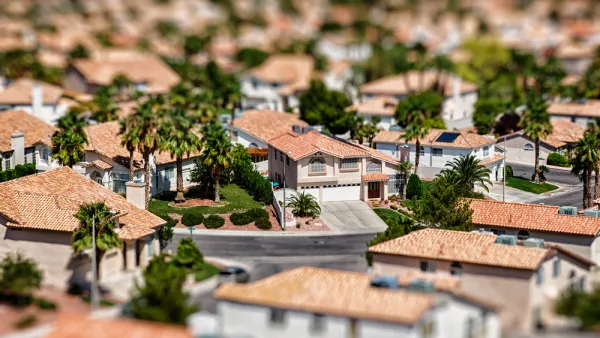
Resilience Planning for Suburban Growth
Whether or not the suburban shift accelerated by the pandemic continues, policymakers can implement climate resilience strategies and guide sustainable growth in both cities and exurbs.

Desperate measures: Advocates weigh draining Lake Powell to fill Colorado River
Draining the reservoir could reduce evaporation losses by a couple hundred thousand acre-feet.

Eastern Nebraska is running out of electricity
Data centers and electrification are straining eastern Nebraska’s grid, throttling economic development.

Malls are becoming the midtowns of the future
Mall and office park redevelopments are a generational opportunity to create new nodes of urbanity.

NYC breaks ground on anti-flooding infrastructure project
New York City's new system will reduce stormwater flows to local sewers by 90%.

One Kentucky town’s secret to affordable housing
The Smoketown Community Land Trust has already built seven affordable homes for community members.

Houston gains petal-shaped cooling infrastructure to make streets more ‘delightful’
The city has installed the pavilions along 15 blocks in Houston.

FREE Course: Walkable City 1: Why Walkability?
After describing his path towards focusing on walkability as the essence of good planning, Jeff Speck marches through his five principal reasons for making more walkable places.
Reinventing Malls: Planning Alchemy—Turning Gray Fields Into Gold
The course focuses on the opportunities and imperatives that shape reinvention of mall sites.

City of Rosemead
Rutgers University, Edward J. Bloustein School of Planning and Public Policy
One Hundred Miles
University of Michigan School for Environment and Sustainability (SEAS)
Hunter College, City University of New York (CUNY)
The Architects Foundation
City of Cambridge
Montrose County
The Pocatello Development Authority