Hurricane Harvey was expected to make landfall late Friday or early Saturday. If the damage in human and economic terms is terrible, a lack of infrastructure maintenance and development responsibility will be to blame.


Jessica Leigh Hester reports on the impending threat of Hurricane Harvey, which as of this writing had yet to make landfall on the Texas Coast.
The article presents the threats presented by Hurricane Harvey as particularly dire. Here's one of the summarizing passages describing the confluence of planning and development decisions that could make Harvey a much more dangerous visitor than previous storms.
As the population has boomed across this Sunbelt city in recent years, an increasing number of people and buildings find themselves in a vulnerable position. Meanwhile, thousands of acres of wetlands that might have helped absorb excess rainfall have been gobbled up by development. When paved surfaces can’t perform the crucial work of stormwater retention, “even lesser storms are invested with more destructive power,” Kriston Capps noted last summer. Harvey is no minor storm—and it is slated to batter a city with relatively poor flood infrastructure and no statewide insurance requirement.
Hester also sits down for an interview with Samuel David Brody, director of the Center for Texas Beaches and Shores at Texas A&M Galveston, to get more insight on what to expect from the storm.
FULL STORY: 'This Storm Has It All'

Criticism for Army Corps' Houston Flood Protection Plans
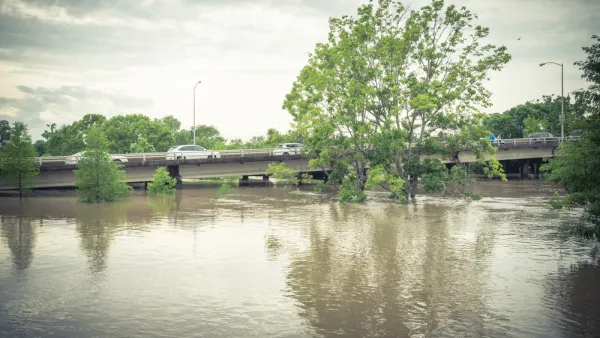
The U.S. Army Corps of Engineers has revised a plan to protect the Houston region from flooding by tossing out a proposed tunnel and opting instead to dig Buffalo Bayou wider and deeper.
Flood Plans, Green Infrastructure Take Center Stage in Houston's Mayoral Race
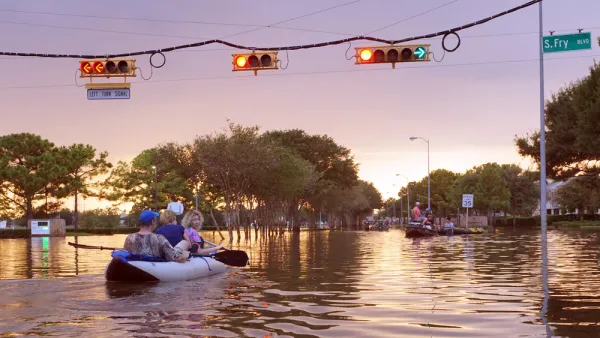
The city of Houston will decide their next mayor in November, in a rematch of the two candidates who ran against each other in a tight runoff election in 2015 as well as a host of additional candidates.
Flooding Less of a Concern as Hurricane Memories Fade
Residents of Houston are less likely to think of flooding as a concern, or to think development should be prohibited in flood-prone areas, as in the years immediately following Hurricane Harvey.

Planetizen Federal Action Tracker
A weekly monitor of how Trump’s orders and actions are impacting planners and planning in America.

The state-sanctioned urbicide of Austin
People don’t kill cities. Freeways do.

US to reduce Colorado River water deliveries to Mexico
A new Colorado Treaty amendment reduces Mexico’s Colorado River water allocation by 250,000 acre feet.

5 New England states march closer to 800 megawatt wind energy project
Securing federal approval for the project may be complicated under the Trump administration, which has historically been hostile towards domestic wind power.

Baltimore to break ground on $50 million Transit Priority Project
The project will bring faster bus trips, safer streets and better bike connections to Baltimore.

Airbnb launches $250 million 'last-dollar financing' housing accelerator, makes first investment in Austin
The company will put $6.4 million towards affordable housing development in Texas’ capital.

FREE Course: Walkable City 1: Why Walkability?
After describing his path towards focusing on walkability as the essence of good planning, Jeff Speck marches through his five principal reasons for making more walkable places.
Reinventing Malls: Planning Alchemy—Turning Gray Fields Into Gold
The course focuses on the opportunities and imperatives that shape reinvention of mall sites.

Eagle County Government
Harvard University Graduate School of Design
Nashville Planning Department
The Architects Foundation
University of Cincinnati Online
The Pocatello Development Authority
The Urban Renewal Agency of the City of Pocatello
Journal of the American Planning Association