Streetsblog USA ponders whether President Trump's $1 trillion big-ticket legislative item was dead before arrival.


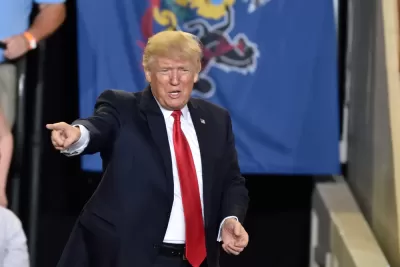
Angie Schmitt performs an autopsy, or sorts, on the Trump Administration's proposed infrastructure plan—a $1 billion campaign pitch that still hasn't been detailed in any substantive way by President Trump or anyone from his administration. (For instance, a press conference meant to be a showcase for Trump's infrastructure agenda devolved into controversy earlier this week.)
Schmitt's article follows the most recent development in the ongoing saga of Trump's infrastructure agenda: a promised "Infrastructure Council" that still hadn't formed won't be forming. Mark Niquette brokes the news about the demise of that never-realized institution.
Schmitt surveys the political scene and declares: "Trump’s inability to stage a mere press conference on infrastructure and the dissolution of his advisory council drive home what has been clear for a long time: His infrastructure plan is going nowhere."
Schmitt also dares to take that conclusion a step further: "The fact that any momentum for Trump’s infrastructure plan has completely dissipated is good news for cities and the climate. All signs were pointing to a sprawl-inducing disaster."
The article links to more resources to gain a full appreciation of this ongoing story of the Trump Administration's infrastructure plan.
FULL STORY: In Case There Was Any Doubt, Trump’s Infrastructure “Plan” Going Nowhere

Trump's Infrastructure Accomplishments Fall Short of Promises
President Trump has fallen short of 2016 promises to update and upgrade the key infrastructure of the United States, according to this article.

Pelosi-Schumer-Trump Infrastructure Plan Already Meeting Resistance
Introduced on April 30, the $2 trillion conceptual plan is likely to be dismissed by Congressional Republicans wary of increasing taxes and adding to the deficit, according to an extensive article by The Hill published three days later.

Democrats Make Peace With Trump for the Sake of a $2 Trillion Infrastructure Plan
Details about what the federal infrastructure plan would spend money, or where it would get the money to spend, have yet to be revealed.

Planetizen Federal Action Tracker
A weekly monitor of how Trump’s orders and actions are impacting planners and planning in America.

The state-sanctioned urbicide of Austin
People don’t kill cities. Freeways do.

US to reduce Colorado River water deliveries to Mexico
A new Colorado Treaty amendment reduces Mexico’s Colorado River water allocation by 250,000 acre feet.

5 New England states march closer to 800 megawatt wind energy project
Securing federal approval for the project may be complicated under the Trump administration, which has historically been hostile towards domestic wind power.

Baltimore to break ground on $50 million Transit Priority Project
The project will bring faster bus trips, safer streets and better bike connections to Baltimore.

Airbnb launches $250 million 'last-dollar financing' housing accelerator, makes first investment in Austin
The company will put $6.4 million towards affordable housing development in Texas’ capital.

FREE Course: Walkable City 1: Why Walkability?
After describing his path towards focusing on walkability as the essence of good planning, Jeff Speck marches through his five principal reasons for making more walkable places.
Reinventing Malls: Planning Alchemy—Turning Gray Fields Into Gold
The course focuses on the opportunities and imperatives that shape reinvention of mall sites.

Eagle County Government
Harvard University Graduate School of Design
Nashville Planning Department
The Architects Foundation
University of Cincinnati Online
The Pocatello Development Authority
The Urban Renewal Agency of the City of Pocatello
Journal of the American Planning Association