Welcome to Velotopia.


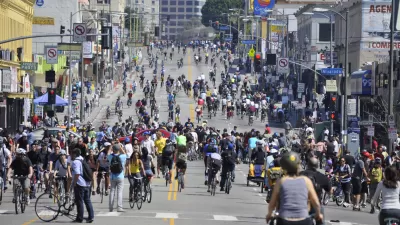
A new book by Steven Fleming, founder of bike-centric planning consultancy Cycle Space, lays out a utopian city built around bicycles as the main form of transportation. In fact, cars are largely illegal in "Velotopia," a complete streets paradise where the flow of traffic is smooth, development is mixed-use and compact, and millions of people find their daily commutes "fun." An edited excerpt in The Guardian showcases the Dutch planner's wry thought experiment.
"No disciples of Le Corbusier, Harvey Corbett, Robert Moses or Norman Bel Geddes have been to Velotopia," Fleming writes. "That means there are no highways and no racks of car-parking stations. Neither have any disciples of Ebenezer Howard been there to suggest that development be clustered around satellite towns with train connections back to the core."
Traffic lights are replaced by roundabouts. Local rail is replaced by solar-powered carts. A few vehicles remain—garbage trucks, ambulances, and construction equipment, primarily—but "there are never more than a few dozen heavy vehicles moving throughout Velotopia at any one time – not enough to warrant a network of service roads."
Read the full story: What would the perfect cycling city look like?
America's Second Protected Intersection Now Open
The first protected intersection opened in August in Davis, Calif., a university town with the nation's highest percentage of bike commuters. Salt Lake City's new protected intersection is explained on NPR's "Here & Now" report with audio and videos.
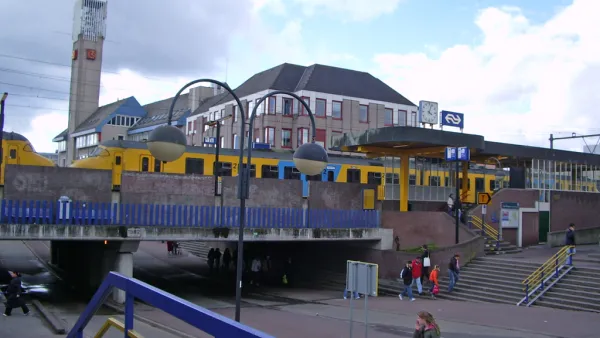
Houten, Netherlands: Where Cars and Bikes Coexist
Well-known in transportation planning circles, Houten's suburban multi-modality can be found almost nowhere else. Perimeter ring roads, train access, and bike-friendly features have cut car trips down to 44 percent.

The Olympics are the perfect excuse to build LA’s dream bike network
With no guaranteed funding for transit, LA should be looking to take as much strain off its Metro system as possible. A vast, interconnected bike network would do just that.

Planetizen Federal Action Tracker
A weekly monitor of how Trump’s orders and actions are impacting planners and planning in America.

Eastern Nebraska is running out of electricity
Data centers and electrification are straining eastern Nebraska’s grid, throttling economic development.

Study reveals best places in the U.S. for cycling, walking
New research from Streetlight Data examines bicycle and pedestrian miles per capita in the 100 largest U.S. cities by population.

Next-generation nuclear reactors are coming to Texas
The reactors will not require towering containment structures thanks to new safety features.

California distributes $1.3 billion to prevent transit service cuts, bolster projects
Twenty-eight projects across California received a portion of the funding.

Pennsylvania Democrats have 15 affordability, clean energy bills for flipped state Senate
Bills in consideration include a bill supporting geothermal energy and a bill supporting solar on warehouses.

FREE Course: Walkable City 1: Why Walkability?
After describing his path towards focusing on walkability as the essence of good planning, Jeff Speck marches through his five principal reasons for making more walkable places.
Reinventing Malls: Planning Alchemy—Turning Gray Fields Into Gold
The course focuses on the opportunities and imperatives that shape reinvention of mall sites.

City of Charlotte
City of Rosemead
Rutgers University, Edward J. Bloustein School of Planning and Public Policy
University of Michigan School for Environment and Sustainability (SEAS)
Hunter College, City University of New York (CUNY)
The Architects Foundation
City of Cambridge
The Pocatello Development Authority
The Urban Renewal Agency of the City of Pocatello