The Honolulu Rail Transit Project was slated to cost $5.2 billion. That figure has doubled as construction progresses, leaving the city scrambling for funds amid public outcry.


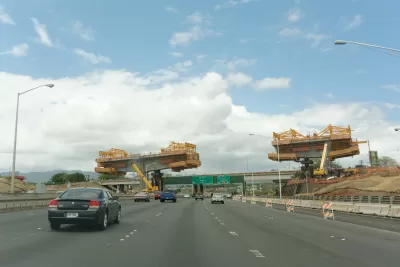
There's a lot of trouble afoot for Honolulu's attempt at traffic-easing transit. Brittany Lyte writes, "In a bid to unsnarl its highways a bit in 2011, the city embarked on a $5.2 billion Honolulu Rail Transit Project. At the time, the planned 20-mile elevated electric train line was expected to ease traffic congestion on Hawaii's most densely populated island by 18 percent, with the first trips planned for 2017."
Six years on, costs have ballooned to $10 billion and rising. "Per capita, the Honolulu rail could become the most expensive transit project in U.S. history, according to the conservative public policy think tank Grassroot Institute of Hawaii."
Will the hugely expensive undertaking actually justify its costs? Estimates say no, predicting only a few percentage points of decreased traffic amid a net increase. Local politicians, including Democrats, are calling for a stop to the bleeding via the withdrawal of federal support, but others feel it's already too late.
Lyte points to transit projects in New Jersey and Maryland that were scuttled due to financial strain and legal challenges.
Read the full story: Honolulu's Rapid Transit Crisis

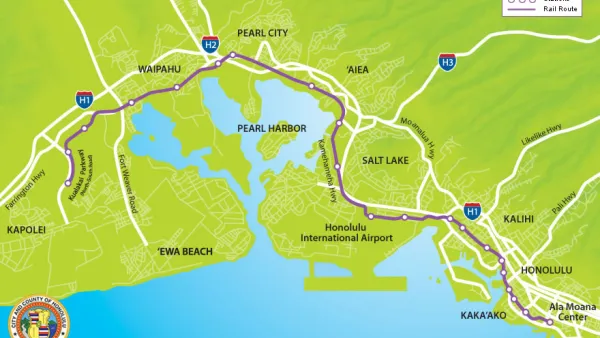
Federal Subpoenas for Honolulu Authority for Rapid Transportation
Bad news for Honolulu's troubled rail transit project: new federal scrutiny and a potential criminal investigation.
Honolulu Rail Transit Makes Progress Despite Financial Woes
Honolulu Rail Transit, a 20-mile, elevated metro rail line, continues to suffer cost overruns and has lost popular support, according to a recent poll. But the tide could change with the arrival of the first rail cars.
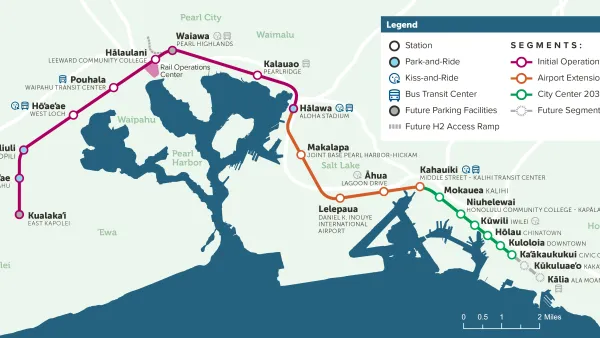
Skyline Rail, Now Serving Honolulu
In a historic day for public transit, Skyline Rail, a project once deemed the worst transit project in the United States due to extreme cost overruns and construction delays, finally opened to the public at the end of June.

Planetizen Federal Action Tracker
A weekly monitor of how Trump’s orders and actions are impacting planners and planning in America.

Amtrak, CN end decades-long dispute with eight-year agreement
The new operating agreement establishes an updated framework for the companies to work together, including processes to resolve disputes.

Judges permit Denver to divert 77,000 acre feet from the Colorado River for reservoir expansion
Overuse and climate change have caused the Colorado River’s water levels to plummet.

NYC DOT wants faster, more permanent street upgrades
The city is examining ways to build more concrete infrastructure without getting entangled in 'decades-long' projects.

'Something we’ve never seen before:' rising utility rates could strain city finances nationwide
Data centers, climate change and other factors have caused utility rates in the United States to increase by 38% since 2020.

Trump to overrule local leaders, lease millions of acres of America’s Pacific Island territories’ seafloors to mining companies
International law says that the Indigenous people of America’s territories have a right to prior and informed consent regarding projects that impact their countries.

FREE Course: Walkable City 1: Why Walkability?
After describing his path towards focusing on walkability as the essence of good planning, Jeff Speck marches through his five principal reasons for making more walkable places.
Reinventing Malls: Planning Alchemy—Turning Gray Fields Into Gold
The course focuses on the opportunities and imperatives that shape reinvention of mall sites.

Harvard University Graduate School of Design
KFH Group Inc.
Greater Baltimore Committee
The Architects Foundation
University of Cincinnati Online
The Pocatello Development Authority
The Urban Renewal Agency of the City of Pocatello