Hoping to give more of a focus and priority to the issues of transportation, the mayor of Denver is proposing a reorganization of city departments.


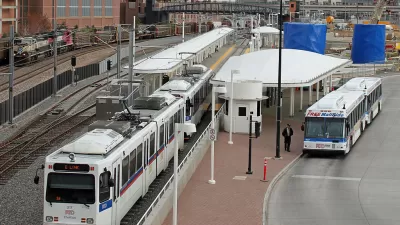
"Denver Mayor Michael Hancock has ordered a reorganization of the Department of Public Works that could lead to the eventual creation of a new Cabinet-level transportation department," reports Jon Murray.
Some city officials and bike, pedestrian and transit advocates have urged such a move as a way to elevate transportation planning. That and other street functions currently are housed under Public Works, which also manages the sewer system, trash removal, water quality projects and the city’s vehicle fleet.
A reorganization that creates a new cabinet-level department would require voter approval, and any such ballot measure is not expected to be ready in time for the November election. Mayor Hancock has a few interim reorganization steps in mind, however, including moving transportation related functions into a single office within Public Works.
Hat tip to Rahcel Dovey for sharing the news and also adding some additional perspective on the experience of Miami-Dade County, which made the opposite reorganization move in early 2016.
Read the full story: Denver Mayor Michael Hancock wants to create a Cabinet-level transportation department
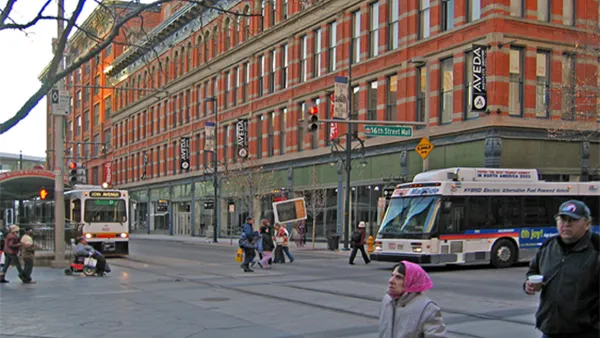
Voters Could Decide if Denver Gets a New Department of Transportation and Infrastructure
Denver is considering a new city department in response to concerns expressed by bike and pedestrian advocates about the implementation of long-term plans.
Denver to Use Marijuana Taxes to Underwrite Affordable Housing Bonds
Mayor Michael Hancock has proposed a funding scheme to ramp up affordable housing production in the city of Denver.
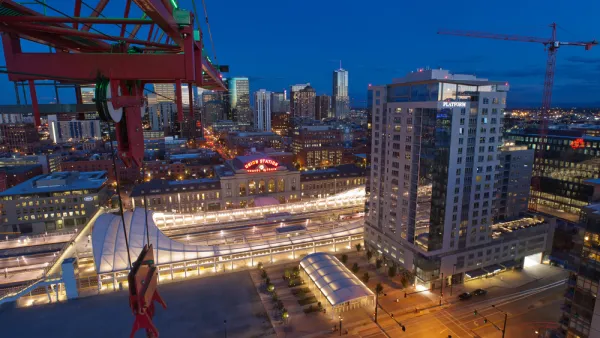
When Post-Recession Development Causes Political Controversy
Denver provides a case study of a city's politics reckoning with the pace of development in a post-recession real estate market.

Planetizen Federal Action Tracker
A weekly monitor of how Trump’s orders and actions are impacting planners and planning in America.

California plans to bury El Niño’s downpour
If the state plays its cards right, it may be able to store a billion acre-feet of El Niño’s water in aquifers.

Desperate measures: Advocates weigh draining Lake Powell to fill Colorado River
Draining the reservoir could reduce evaporation losses by a couple hundred thousand acre-feet.

Mamdani’s pied-à-terre tax survives legal challenge
A panel of judges found that the plaintiffs failed to demonstrate injury as a result of New York City's implementation of the tax.

Eastern Nebraska is running out of electricity
Data centers and electrification are straining eastern Nebraska’s grid, throttling economic development.

Seattle passes record-breaking transit services expansion
Proposition 1 will double the city’s transit tax to add 95,000 more bus trips and preserve 180,000 bus trips annually.

FREE Course: Walkable City 1: Why Walkability?
After describing his path towards focusing on walkability as the essence of good planning, Jeff Speck marches through his five principal reasons for making more walkable places.
Reinventing Malls: Planning Alchemy—Turning Gray Fields Into Gold
The course focuses on the opportunities and imperatives that shape reinvention of mall sites.


City of Rosemead
Rutgers University, Edward J. Bloustein School of Planning and Public Policy
One Hundred Miles
University of Michigan School for Environment and Sustainability (SEAS)
Hunter College, City University of New York (CUNY)
The Architects Foundation
City of Cambridge
Montrose County
The Pocatello Development Authority