In Philadelphia, the William Penn Foundation has committed to help raise the last $10 million of the $225 million budget for a park over the I-95.


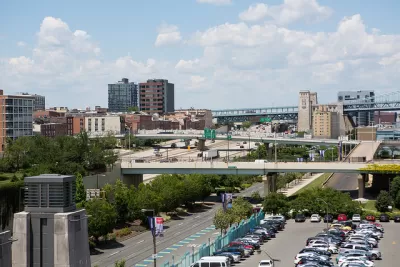
Philadelphia's riverfront could be getting two miles of protected bike lanes and four acres of park land if the last of the funds for the project can be raised, and now the William Penn Foundation has promised their support to help raise the final $10 million. "With the pledge, construction is on track to begin in 2019, with work expected to last three years, officials said at a Friday news conference atop a Penn’s Landing parking structure overlooking the section of highway that would be capped," Jacob Adelman writes in the Philadelphia Inquirer.
"Gov. Wolf said Friday that the park, which will slope toward Penn’s Landing, and the extended South Street pedestrian bridge will reconnect Center City with the Delaware River waterfront, which was cleaved from the city by I-95," Adelman reports. The article includes a rendering of the planned park, designed by Hargreaves and Associates.
Read the full story: Plans for park over I-95 inch toward reality with fund-raising pledge

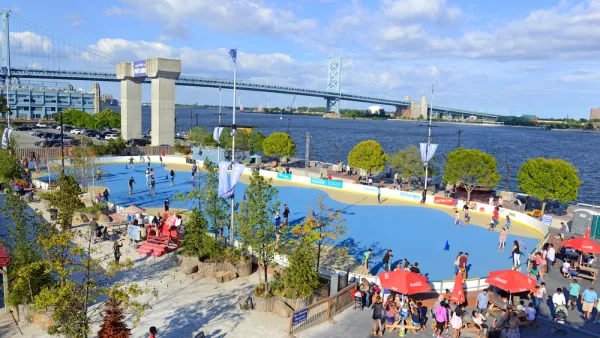
Philadelphia's Freeway Cap Park Almost Fully Funded, Ready to Start Planning
March was a momentous month for the Central Access Philadelphia (CAP) project. The project would build cap over I-95 at Penn's Landing, among other improvements.
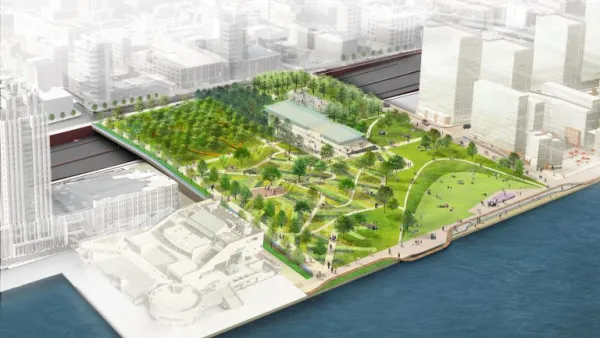
Philadelphia's Waterfront Cap Park Enters Final Design Phase
The $225 million Park at Penn's Landing is expected to compete transform the city of Philadelphia's relationship with its waterfront.
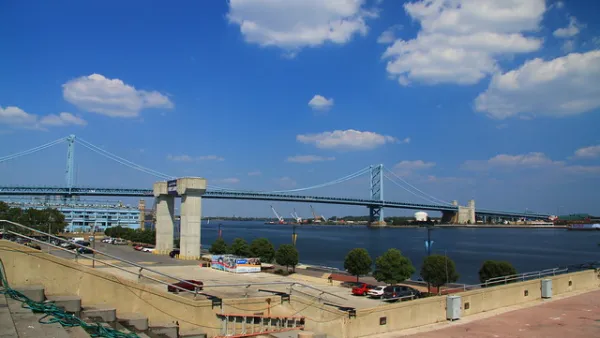
Iconic Remnants of Failed Tram on the Philly Waterfront to Be Demolished
It's the end of an era that never was.

Planetizen Federal Action Tracker
A weekly monitor of how Trump’s orders and actions are impacting planners and planning in America.

California plans to bury El Niño’s downpour
If the state plays its cards right, it may be able to store a billion acre-feet of El Niño’s water in aquifers.

Chicago breaks ground on $3 billion megadevelopment
The new neighborhood, titled Foundry Park, will one day host 3,700 residences.

California High-Speed Rail Authority CEO resigns after $600,000 scandal
Under Ian Choudri, the authority used taxpayer dollars to fund first class flights and trips to nightclubs.

Want to study the Missouri River? Soon, you may need unanimous approval from 10 states
Legislation would require 10 governors’ permission to study or build projects moving water outside the basin.

Desperate measures: Advocates weigh draining Lake Powell to fill Colorado River
Draining the reservoir could reduce evaporation losses by a couple hundred thousand acre-feet.

FREE Course: Walkable City 1: Why Walkability?
After describing his path towards focusing on walkability as the essence of good planning, Jeff Speck marches through his five principal reasons for making more walkable places.
Reinventing Malls: Planning Alchemy—Turning Gray Fields Into Gold
The course focuses on the opportunities and imperatives that shape reinvention of mall sites.

City of Rosemead
Rutgers University, Edward J. Bloustein School of Planning and Public Policy
One Hundred Miles
Hunter College, City University of New York (CUNY)
The Architects Foundation
University of Cincinnati Online
City of Cambridge
Montrose County
The Pocatello Development Authority