Touted as a leader among the European cities moving toward car-free streets, Oslo's ambitions of removing all cars from the city center has hit some roadblocks.



"When a progressive political alliance took power over Oslo’s city council in October 2015, they had made one of their first priorities a greener and more liveable environment in the city," according to an article by Athlyn Cathcart-Keays. "If pulled off, the plan would see Oslo become the first major European city to have a permanent, complete no-car-zone, racing ahead of a long list of cities seeking to do the same."
There was just one problem, Cathcart-Keays: backlash from conservative politicians and the city's trade association.
In response, the city has changed course deciding to ban parking and limit the lanes available to cars (even electric cars) throughout the city center. That plan has also proven unpopular with some in the city, however, which Cathcart-Keays explains in more detail.
Read the full story: Oslo's car ban sounded simple enough. Then the backlash began
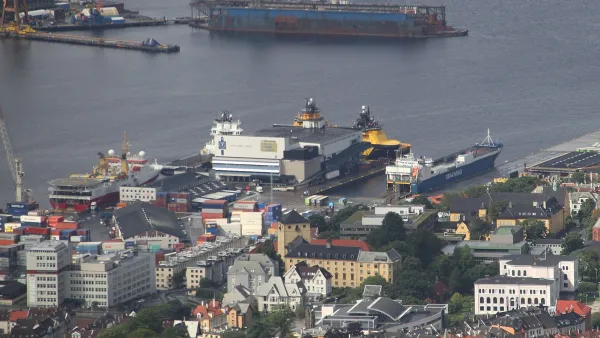
Norwegian City Plans for Zero-Emissions Neighborhood
As it winds down port operations in the area, Bergen plans to transform its Dokken district from a busy shipping hub to a car-free, 'regenerative' zone.
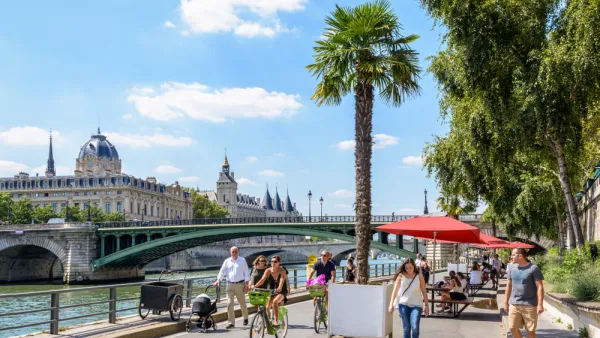
The Car-Free Revolution Continues in Paris
The city continues to reclaim space for pedestrians and cyclists.
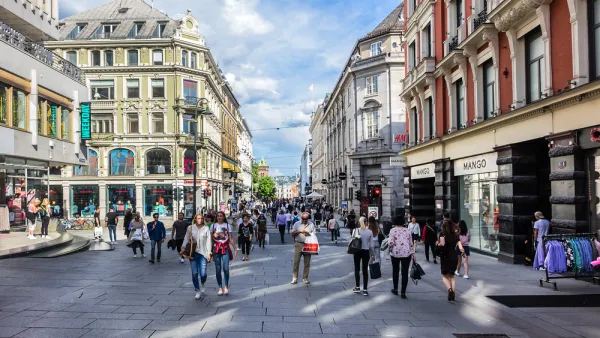
Watch: The Car-Free City Becomes Reality
The latest City Beautiful video shows off the fruits of car-free initiatives in European cities.

Planetizen Federal Action Tracker
A weekly monitor of how Trump’s orders and actions are impacting planners and planning in America.

California plans to bury El Niño’s downpour
If the state plays its cards right, it may be able to store a billion acre-feet of El Niño’s water in aquifers.

Desperate measures: Advocates weigh draining Lake Powell to fill Colorado River
Draining the reservoir could reduce evaporation losses by a couple hundred thousand acre-feet.

Mamdani’s pied-à-terre tax survives legal challenge
A panel of judges found that the plaintiffs failed to demonstrate injury as a result of New York City's implementation of the tax.

Eastern Nebraska is running out of electricity
Data centers and electrification are straining eastern Nebraska’s grid, throttling economic development.

Seattle passes record-breaking transit services expansion
Proposition 1 will double the city’s transit tax to add 95,000 more bus trips and preserve 180,000 bus trips annually.

FREE Course: Walkable City 1: Why Walkability?
After describing his path towards focusing on walkability as the essence of good planning, Jeff Speck marches through his five principal reasons for making more walkable places.
Reinventing Malls: Planning Alchemy—Turning Gray Fields Into Gold
The course focuses on the opportunities and imperatives that shape reinvention of mall sites.

City of Rosemead
Rutgers University, Edward J. Bloustein School of Planning and Public Policy
One Hundred Miles
University of Michigan School for Environment and Sustainability (SEAS)
Hunter College, City University of New York (CUNY)
The Architects Foundation
City of Cambridge
Montrose County
The Pocatello Development Authority