New York is piloting new building design guidelines aimed at improving the city's climate resiliency.


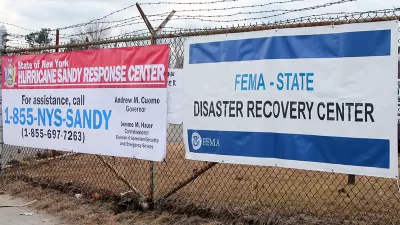
New guidelines out of Mayor de Blasio's office call for building bioswales and permeable roads, as well as using green roofs, reflective surfaces, and other climate-resilient features on new city facilities. Released last month, the proposed guidelines are being piloted by the mayor's Office of Recovery and Resiliency before being finalized.
Acknowledging New York's unique vulnerability to extreme weather, the document also reflects a shifting orientation to planning for the impacts of climate change:
Building regulations have relied on historical data for temperatures or storm surges, but now New York will look ahead to future projections across four areas of climate risk: storm level surges, sea-level rise, higher temperatures, and escalating peak precipitation.
Although structured as recommendations rather than requirements, the guidelines will apply to "all of the city government’s capital projects, from libraries to bridges," the Architectural Record reports.
Read the full story: New York City Releases First Climate Resiliency Design Guidelines

New York Resilience Plan to Get Second Opinion
The price tag for the de Blasio administration’s stormwater and sea-level rise plan rose $1.3 billion after some costly additions. Now some city council members are bringing in a second group to examine the plan.

Over 500 NYC ‘Blue Zones’ at Risk of More Destructive Floods
High-risk flood zones cover roughly 20% of the city’s land.
New Yorkers Face New Climate Risks
A two-acre fire in a city park prompted city officials to ban grilling while urging residents to conserve water to limit the impact of a historic drought.

Planetizen Federal Action Tracker
A weekly monitor of how Trump’s orders and actions are impacting planners and planning in America.

Amtrak, CN end decades-long dispute with eight-year agreement
The new operating agreement establishes an updated framework for the companies to work together, including processes to resolve disputes.

Judges permit Denver to divert 77,000 acre feet from the Colorado River for reservoir expansion
Overuse and climate change have caused the Colorado River’s water levels to plummet.

Atlanta City Council unanimously backs $3.5 billion Beltline light rail project
The resolution was drafted after Atlanta Mayor Andre Dickens pulled support for the Atlanta Streetcar extension last year.

SEPTA to bring nearby frequent transit to over 1 million new riders as part of decade-long plan
The agency's Accelerate plan will also bring frequent transit to twice the amount of jobs that are currently located near it.

NYC plants over 18,000 trees, the most new foliage in a decade
Many of the trees were planted in communities vulnerable to extreme heat.

FREE Course: Walkable City 1: Why Walkability?
After describing his path towards focusing on walkability as the essence of good planning, Jeff Speck marches through his five principal reasons for making more walkable places.
Reinventing Malls: Planning Alchemy—Turning Gray Fields Into Gold
The course focuses on the opportunities and imperatives that shape reinvention of mall sites.

City of Thousand Oaks
City of Wisconsin Rapids
Harvard University Graduate School of Design
The Architects Foundation
University of Cincinnati Online
The Pocatello Development Authority
The Urban Renewal Agency of the City of Pocatello