Florida is infamous for the lack of safety on its roads. A new interactive graphic of the nation's most dangerous highways does nothing to dispel that reputation.


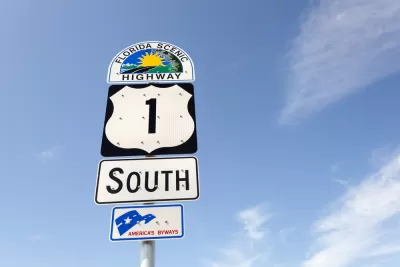
Geotab recently published an interactive graphic that maps out the most dangerous highway in each U.S. state. They calculated a fatal crash rate "based on the annual number of road fatalities and fatal crashes according to the National Highway Traffic Safety Administration, adjusted for the average daily traffic counts provided by the Federal Highway Administration."
The state with the most dangerous highway of all: Florida, where US-1 has a fatal crash rate of 2.8, followed by Texas, where US-83 has a fatal crash rate of 2.0, and California, where I-40 has a fatal crash rate of 1.8. I-40's path of destruction continues into the forth and fifth ranked states, too—Arizona and New Mexico. The state with the safest most dangerous highway: Rhode Island, where I-95 has a fatal crash rate of 0.1.
Read the full story: The Most Dangerous Highways in America

Let’s End Traffic Stops
The technology to make traffic enforcement obsolete is becoming available. But in the U.S. willing to use it?
Legal Marijuana Still a Challenge for Road Safety
The state of Washington is finding that more and more fatal car crashes involve drivers under the influence of THC. But legal limbo, lack of research, and spotty detection makes the question of what to do very hard to answer.
The Numbers Behind the Country’s Decreasing Traffic Fatalities
Susannah Locke examines some of the data behind the United State’s steady decrease in auto fatalities since a peak in 1969, when 55,043 people died while driving.

Planetizen Federal Action Tracker
A weekly monitor of how Trump’s orders and actions are impacting planners and planning in America.

California plans to bury El Niño’s downpour
If the state plays its cards right, it may be able to store a billion acre-feet of El Niño’s water in aquifers.

Desperate measures: Advocates weigh draining Lake Powell to fill Colorado River
Draining the reservoir could reduce evaporation losses by a couple hundred thousand acre-feet.

Mamdani’s pied-à-terre tax survives legal challenge
A panel of judges found that the plaintiffs failed to demonstrate injury as a result of New York City's implementation of the tax.

Eastern Nebraska is running out of electricity
Data centers and electrification are straining eastern Nebraska’s grid, throttling economic development.

Seattle passes record-breaking transit services expansion
Proposition 1 will double the city’s transit tax to add 95,000 more bus trips and preserve 180,000 bus trips annually.

FREE Course: Walkable City 1: Why Walkability?
After describing his path towards focusing on walkability as the essence of good planning, Jeff Speck marches through his five principal reasons for making more walkable places.
Reinventing Malls: Planning Alchemy—Turning Gray Fields Into Gold
The course focuses on the opportunities and imperatives that shape reinvention of mall sites.

City of Rosemead
Rutgers University, Edward J. Bloustein School of Planning and Public Policy
One Hundred Miles
University of Michigan School for Environment and Sustainability (SEAS)
Hunter College, City University of New York (CUNY)
The Architects Foundation
City of Cambridge
Montrose County
The Pocatello Development Authority