Building over highways is not a particularly new idea, but it has been a rare novelty. Former SPUR director and development consultant Jim Chappell sees a brighter future for highway caps parks and projects.


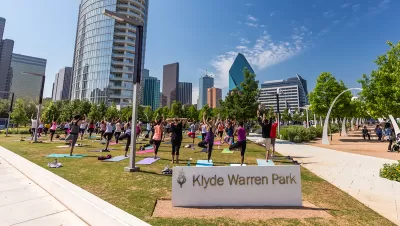
With the price of urban real estate going up and up, highway airspace development becomes more viable. There are numerous projects around the country, both past and future. SPUR's former director, now a consultant, reviews a few and sees a promising future for developing in airspace over freeways and highways. He notes:
. . . there are currently 20 other parks over or replacing highways in the US and at least another 26 in some stage of proposal.
Chappell notes that while existing caps are parks or convention centers, that's changing:
In the District of Columbia, Property Group Partners are building a 7.5 acre, $1.3 billion project with five-130 foot high, mixed use commercial, office and residential buildings, totaling 2.2 million leasable square feet. All of this, plus 1.5 acres of open space, over the 3-block long, 200 foot wide, eight lane Center Leg Freeway (I-395). The lid will be completed this year, and the first building is projected to open in 2018. When complete in 2022, the project is anticipated to generate $40 million per year in property taxes alone.[4]
If $1.3 billion sounds expensive, consider Hudson Yards, two superblocks on the West side of Manhattan. Related Companies is in the midst of constructing a $25 billion 28-acre neighborhood with 18 million square feet of mixed use, all over operating rail yards. [5] $25 billion!
Read the full story: Don’t listen to Mark Twain – freeway caps gaining traction

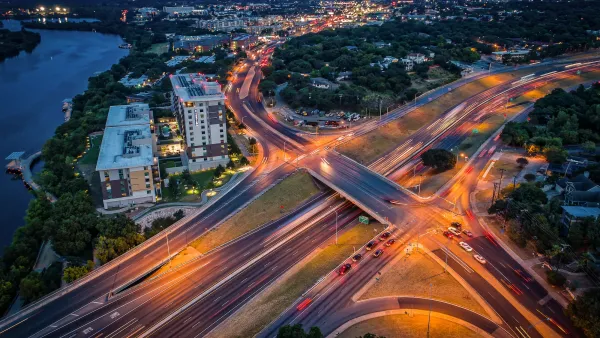
Austin Officials Pump the Brakes on I-35 ‘Cap & Stitch’ Project
The city approved a plan to build cap parks over parts of I-35 less than a year ago.

Philadelphia’s ‘Chinatown Stitch’ Freeway Cap in Danger After Feds Retract Funding
A project 15 years in the making would reconnect Philadelphia’s Chinatown neighborhood after decades of being split in half by a roadway.
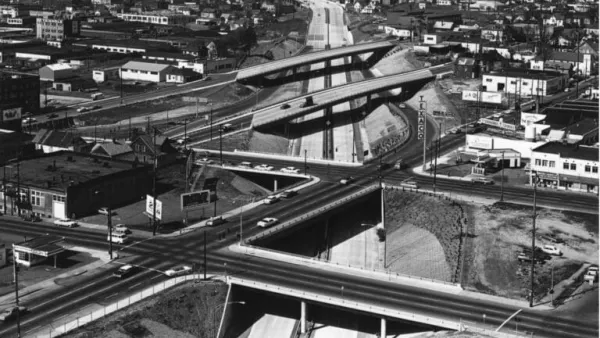
Will the Reconnecting Communities Program Survive Trump?
A freeway cap in Portland, Oregon is in jeopardy. But the visionary “restorative redevelopment” next door goes on.

Planetizen Federal Action Tracker
A weekly monitor of how Trump’s orders and actions are impacting planners and planning in America.

Amtrak, CN end decades-long dispute with eight-year agreement
The new operating agreement establishes an updated framework for the companies to work together, including processes to resolve disputes.

Judges permit Denver to divert 77,000 acre feet from the Colorado River for reservoir expansion
Overuse and climate change have caused the Colorado River’s water levels to plummet.

NYC DOT wants faster, more permanent street upgrades
The city is examining ways to build more concrete infrastructure without getting entangled in 'decades-long' projects.

'Something we’ve never seen before:' rising utility rates could strain city finances nationwide
Data centers, climate change and other factors have caused utility rates in the United States to increase by 38% since 2020.

Trump to overrule local leaders, lease millions of acres of America’s Pacific Island territories’ seafloors to mining companies
International law says that the Indigenous people of America’s territories have a right to prior and informed consent regarding projects that impact their countries.

FREE Course: Walkable City 1: Why Walkability?
After describing his path towards focusing on walkability as the essence of good planning, Jeff Speck marches through his five principal reasons for making more walkable places.
Reinventing Malls: Planning Alchemy—Turning Gray Fields Into Gold
The course focuses on the opportunities and imperatives that shape reinvention of mall sites.

Harvard University Graduate School of Design
KFH Group Inc.
Greater Baltimore Committee
The Architects Foundation
University of Cincinnati Online
The Pocatello Development Authority
The Urban Renewal Agency of the City of Pocatello