As the Outdoor Industry Association gathered for its annual advocacy trip to Washington, D.C., the industry is marshaling its resources for an expected political battle with the Trump Administration.



Jason Belvins reports on an emerging political voice in the debate over public lands:
With the news that the outdoor economy — defined by bike, snow, trail and water sports as well as camping, fishing, hunting, motorcycling, off-roading and wildlife viewing — supports more than 7.6 million jobs and pays $124.5 billion in federal, state and local taxes, the outdoor industry right now is circling its wagons in Washington D.C., hoping to champion the role of outdoor play in not just the health of Americans but the country’s economy.
The article follows on an earlier article written by Blevins detailing the emergence of the outdoor recreation industry as an economic force to be reckoned with in the debate over the protection of public lands. The new report by the Boulder-based Outdoor Industry Association reaffirms the industry's size and scope.
The report also comes during a week when President Donald Trump is expected to "order a review of all national monument designations over the last two decades, asking the Interior Department to examine whether the scope of the monument designations follows the intent of the Antiquities Act, which allows presidents to create such protections," as Blevins explains. Juliet Eilperin broke the news on the expected order for The Washington Post.
Read the full story: Outdoor recreation industry, seeing role to protect public lands, boasts $887 billion impact
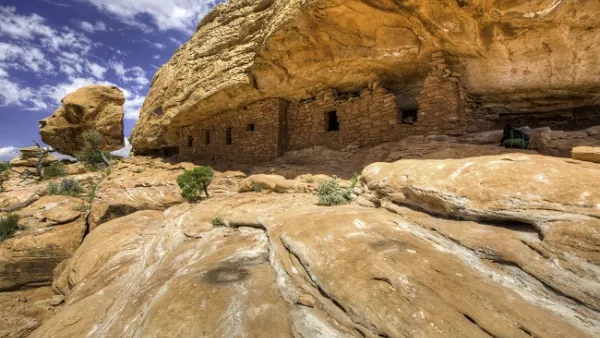
Antiquities Act Executive Order Calls for Review of Large Designations
The Executive Order does not roll back the Antiquities Act nor rescind any designations made by presidents Clinton, George W. Bush, or Obama, but does call for their review if over 100,000 acres. President Trump feels that the act has been misused.
Monument Review: Recreation a Larger Economic Benefit Than Ranching and Timber Combined
Why is the Department of Interior considering a reduction of the size of the Cascade-Siskiyou National Monument?
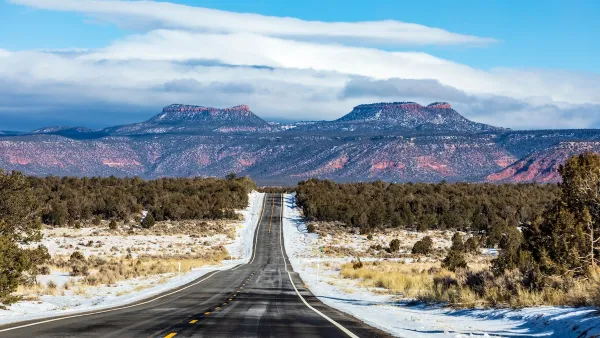
National Monuments Under Threat From Mining Under New Executive Order
An executive order from the Department of the Interior could gut protections for public lands established under the Antiquities Act.

Planetizen Federal Action Tracker
A weekly monitor of how Trump’s orders and actions are impacting planners and planning in America.

Eastern Nebraska is running out of electricity
Data centers and electrification are straining eastern Nebraska’s grid, throttling economic development.

Study reveals best places in the U.S. for cycling, walking
New research from Streetlight Data examines bicycle and pedestrian miles per capita in the 100 largest U.S. cities by population.

Why does it take an emergency for the U.S. to expedite infrastructure projects?
In June 2023, Philadelphia repaired a melted interstate in 12 days thanks to an emergency order.

Federal government nominates new FTA administrator
Mark Aesch is currently the founder and CEO of a transportation management consulting firm.

Developers reveal $10 billion stadium plan as ‘Hail Mary’ to keep Bears in Chicago
The plan would also boast a public park, high- and mid-rise buildings and a youth sports complex.

FREE Course: Walkable City 1: Why Walkability?
After describing his path towards focusing on walkability as the essence of good planning, Jeff Speck marches through his five principal reasons for making more walkable places.
Reinventing Malls: Planning Alchemy—Turning Gray Fields Into Gold
The course focuses on the opportunities and imperatives that shape reinvention of mall sites.

City of Charlotte
City of Rosemead
Rutgers University, Edward J. Bloustein School of Planning and Public Policy
University of Michigan School for Environment and Sustainability (SEAS)
Hunter College, City University of New York (CUNY)
The Architects Foundation
City of Cambridge
The Pocatello Development Authority
The Urban Renewal Agency of the City of Pocatello