New York City has commenced a Uniform Land Use Review Procedure (ULURP) in the neighborhood of East Harlem. This would be the second rezoning toward Mayor de Blasio's goal for 15 rezonings.



"[New York City] took the first major step Monday to rezone a large swath of East Harlem in what would be the second neighborhood rezoned under the mayor’s Mandatory Inclusionary Housing program," reports Kathryn Brenzel.
"The City Planning Commission certified a proposal to rezone a 96-block area of the neighborhood," adds Brenzel. "Officials estimate that the rezoning could create as many as 3,500 units of new housing, some of which will be permanently affordable."
The East Harlem ULURP is the second in in Mayor Bill de Blasio's term, and the second since the city approved a Mandatory Inclusionary Housing ordinance. Mayor de Blasio set a target to rezone 15 neighborhoods under the ordinance to help spur the construction of badly needed housing supply, but so far only East New York has been approved, after a series of setbacks and community opposition slowed the process in other parts of the city.
Read the full story: City Planning kickstarts East Harlem rezoning review process

New York City Council Approves Sweeping Zoning Changes
Politico New York reports all the important details on a big day for planning in New York City—as the City Council overwhelmingly approved two controversial zoning changes to help spur the construction of affordable housing.
Explained: East New York's Big Zoning Changes
Some residents of East New York argue that mandatory inclusionary zoning and other changes proposed for the neighborhood will only help displace low-income residents.
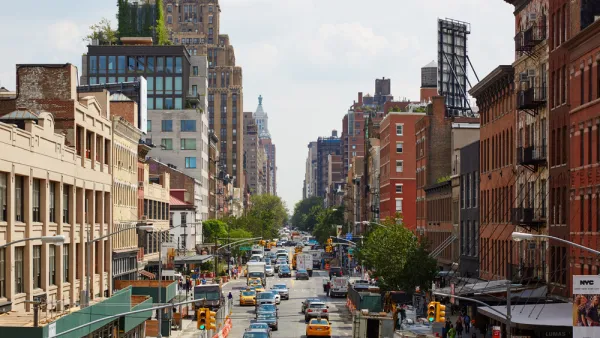
Five More Affluent NYC Neighborhoods to Upzone
In keeping with the goals of the Regional Plan Association's Fourth Regional Plan, New York City must continue its nascent trend of rezoning for more building capacity in affluent neighborhoods.

Planetizen Federal Action Tracker
A weekly monitor of how Trump’s orders and actions are impacting planners and planning in America.

California plans to bury El Niño’s downpour
If the state plays its cards right, it may be able to store a billion acre-feet of El Niño’s water in aquifers.

Chicago breaks ground on $3 billion megadevelopment
The new neighborhood, titled Foundry Park, will one day host 3,700 residences.

California High-Speed Rail Authority CEO resigns after $600,000 scandal
Under Ian Choudri, the authority used taxpayer dollars to fund first class flights and trips to nightclubs.

Want to study the Missouri River? Soon, you may need unanimous approval from 10 states
Legislation would require 10 governors’ permission to study or build projects moving water outside the basin.

Desperate measures: Advocates weigh draining Lake Powell to fill Colorado River
Draining the reservoir could reduce evaporation losses by a couple hundred thousand acre-feet.

FREE Course: Walkable City 1: Why Walkability?
After describing his path towards focusing on walkability as the essence of good planning, Jeff Speck marches through his five principal reasons for making more walkable places.
Reinventing Malls: Planning Alchemy—Turning Gray Fields Into Gold
The course focuses on the opportunities and imperatives that shape reinvention of mall sites.

City of Rosemead
Rutgers University, Edward J. Bloustein School of Planning and Public Policy
One Hundred Miles
Hunter College, City University of New York (CUNY)
The Architects Foundation
University of Cincinnati Online
City of Cambridge
Montrose County
The Pocatello Development Authority