The city of New Orleans has a plan to remove four monuments to the Confederate States of America, deciding that monuments to the racist cause of the Confederacy belong in a museum, not in the city.



"Efforts to remove four Confederate monuments commenced early Monday morning (April 24), as crews and police gathered around the Battle of Liberty Place monument downtown around 2 a.m. to begin dismantling the first of four statues eyed for removal by the city," reports Beau Evans.
The action required police snipers and a barricade around the monument as crews removed the monument. The monument's removal was made possible by a 2015 ordinance backed by Mayor Landrieu. In a press release to announce the Battle of Liberty Place monument, Mayor Landrieu “The removal of these statues sends a clear and unequivocal message to the people of New Orleans and the nation: New Orleans celebrates our diversity, inclusion and tolerance,”
"Mayor Mitch Landrieu has called the Battle of Liberty Place monument the 'most offensive, of the four up for removal," according to Evans. "Erected in 1891, it commemorates the Crescent City White League-attempt to overthrow the city's Reconstructionist government after the Civil War."
Nicole Chavez and Emanuella Grinberg also reported the news of the late-night/early-morning monument removal for CNN. German Lopez also followed up on the news for a post on Vox, also providing a recap of that website's past arguments to connect the Confederacy inextricably from the institution of slavery.
Read the full story: Removal of the first of four New Orleans Confederate monuments begins with Liberty Place
Louisiana State Senate Votes to Preempt Locals on Inclusionary Zoning
Earlier this week, the Louisiana State Senate approved SB 462, which preempts local authorities from approving inclusionary zoning.
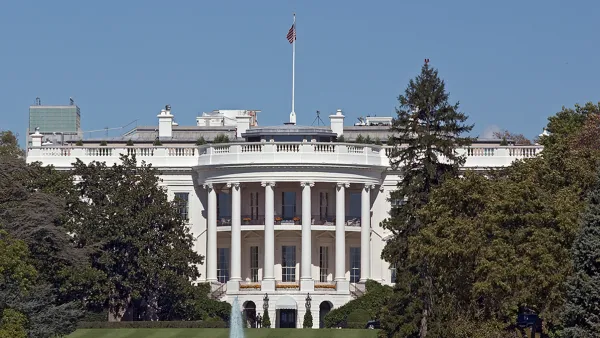
Rift Grows Between U.S. Conference of Mayors and the White House
A delegation of mayors cancelled a scheduled visit to the White House this week after the Trump Administration ramped up attacks on sanctuary cities.

Hurricane Nate to Test New Orlean's Drainage System
Nate will make landfall southeast of New Orleans on Saturday night as possibly a category 2 hurricane after leaving at least 22 dead in Central America. It's not so much the levees but the pumps and generators that have city officials worried.

Planetizen Federal Action Tracker
A weekly monitor of how Trump’s orders and actions are impacting planners and planning in America.

California plans to bury El Niño’s downpour
If the state plays its cards right, it may be able to store a billion acre-feet of El Niño’s water in aquifers.

Desperate measures: Advocates weigh draining Lake Powell to fill Colorado River
Draining the reservoir could reduce evaporation losses by a couple hundred thousand acre-feet.

Housing is the top priority of Seattle’s sole new councilmember
Jenks campaigned on building 1,000 new units of affordable housing.

New tax cuts may slash $1.5 billion in funding for Miami transit, public parks
Amendment 3 will save Miami-Dade homeowners $2,700 in 2028.

Arizona, Wisconsin, Pennsylvania hope to finally advance climate goals post-midterms
The three states have spent years under Republican or divided control.

FREE Course: Walkable City 1: Why Walkability?
After describing his path towards focusing on walkability as the essence of good planning, Jeff Speck marches through his five principal reasons for making more walkable places.
Reinventing Malls: Planning Alchemy—Turning Gray Fields Into Gold
The course focuses on the opportunities and imperatives that shape reinvention of mall sites.


City of Rosemead
Rutgers University, Edward J. Bloustein School of Planning and Public Policy
One Hundred Miles
University of Michigan School for Environment and Sustainability (SEAS)
Hunter College, City University of New York (CUNY)
The Architects Foundation
City of Cambridge
Montrose County
The Pocatello Development Authority