Richard Florida calls for the use of the term "New Urban Luddites" to describe the embedded interests that obstruct the growth of cities. The consequences of New Urban Luddite politics, according to Florida, are too severe for such an innocuous term.


Richard Florida sets the stakes for this discussion of land use politics thusly: "NIMBYism has grown substantially over time, and it now erupts in opposition to all manner of new development. This behavior isn’t just selfish; it’s destructive. By limiting density and clustering, NIMBYs hold back the urban innovation that powers growth."
Those stakes are why Florida prefers to call NIMBYs by a new term: the New Urban Luddites. According to Florida, "New Urban Luddism is codified in the enormous and complex thicket of zoning laws and other land use regulations that restrict the supply of housing in many cities," but simply rescinding land use regulations isn't the solution to the challenges posed by New Urban Luddites. "What our cities need is not just deregulation, but a reformed land use system that, together with broad changes in the tax system, increased investment in transit, and a shift from single-family homes to rental housing, can help create the kinds of density, clustering, and talent mixing that the urbanized knowledge economy requires."
FULL STORY: Meet the 'New Urban Luddites'

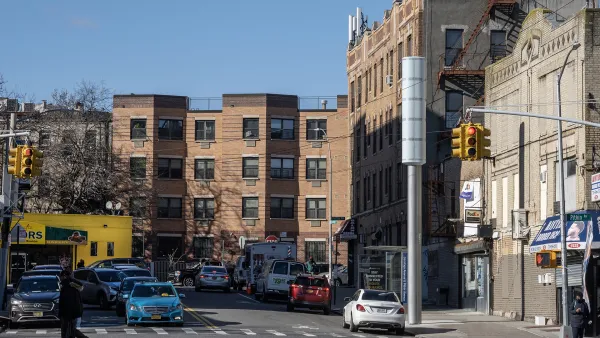
NYC's Link5G Towers Face Neighborhood Opposition
More than 2,000 32-foot towers are coming to New York City street corners to improve 5G connectivity throughout the city, and residents aren’t happy, citing incompatible design and visual distraction as a threat to safety.

Montana Land Use Reform Overhauls Public Participation Rules
In a bid to streamline housing permits, new state legislation limits public input to the land use planning stage.

Converting Golf Courses to Housing Never as Easy as the Market Would Like
Thousands of golf courses have closed in recent years, but the obvious redevelopment opportunity represented by many defunct courses isn’t always easy to realize.

The state-sanctioned urbicide of Austin
People don’t kill cities. Freeways do.

US to reduce Colorado River water deliveries to Mexico
A new Colorado Treaty amendment reduces Mexico’s Colorado River water allocation by 250,000 acre feet.

New Jersey’s second-largest city bans standalone data centers
Jersey City will continue to allow co-location facilities, such as those meant for research institutions that store their own data.

Amtrak not solely to blame for New Jersey commuter rail's unreliability, report finds
A new study from the Garden State Initiative found that NJ Transit’s budget grew 20% across a 4 year period, but reliability declined significantly over the same period.

EPA erases limits on planet-warming pollution from power plants
Under Monday’s plan, power plants would still have some limits on how much mercury, arsenic and other contaminants they can emit.

Phoenix announces new on-demand transit service, more frequent RAPID buses
Both new services will launch in October, and are part of Phoenix's Project Effective Access Solutions for Easing Congestion.

FREE Course: Walkable City 1: Why Walkability?
After describing his path towards focusing on walkability as the essence of good planning, Jeff Speck marches through his five principal reasons for making more walkable places.
Reinventing Malls: Planning Alchemy—Turning Gray Fields Into Gold
The course focuses on the opportunities and imperatives that shape reinvention of mall sites.

Eagle County Government
Harvard University Graduate School of Design
Nashville Planning Department
The Architects Foundation
University of Cincinnati Online
The Pocatello Development Authority
The Urban Renewal Agency of the City of Pocatello
Journal of the American Planning Association