Richard Florida calls for the use of the term "New Urban Luddites" to describe the embedded interests that obstruct the growth of cities. The consequences of New Urban Luddite politics, according to Florida, are too severe for such an innocuous term.


Richard Florida sets the stakes for this discussion of land use politics thusly: "NIMBYism has grown substantially over time, and it now erupts in opposition to all manner of new development. This behavior isn’t just selfish; it’s destructive. By limiting density and clustering, NIMBYs hold back the urban innovation that powers growth."
Those stakes are why Florida prefers to call NIMBYs by a new term: the New Urban Luddites. According to Florida, "New Urban Luddism is codified in the enormous and complex thicket of zoning laws and other land use regulations that restrict the supply of housing in many cities," but simply rescinding land use regulations isn't the solution to the challenges posed by New Urban Luddites. "What our cities need is not just deregulation, but a reformed land use system that, together with broad changes in the tax system, increased investment in transit, and a shift from single-family homes to rental housing, can help create the kinds of density, clustering, and talent mixing that the urbanized knowledge economy requires."
Read the full story: Meet the 'New Urban Luddites'
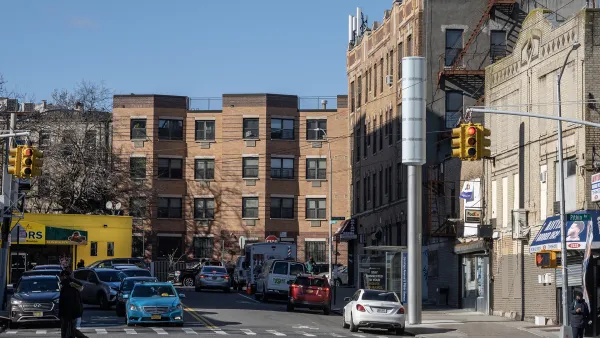
NYC's Link5G Towers Face Neighborhood Opposition
More than 2,000 32-foot towers are coming to New York City street corners to improve 5G connectivity throughout the city, and residents aren’t happy, citing incompatible design and visual distraction as a threat to safety.

Montana Land Use Reform Overhauls Public Participation Rules
In a bid to streamline housing permits, new state legislation limits public input to the land use planning stage.

Converting Golf Courses to Housing Never as Easy as the Market Would Like
Thousands of golf courses have closed in recent years, but the obvious redevelopment opportunity represented by many defunct courses isn’t always easy to realize.

Planetizen Federal Action Tracker
A weekly monitor of how Trump’s orders and actions are impacting planners and planning in America.

California plans to bury El Niño’s downpour
If the state plays its cards right, it may be able to store a billion acre-feet of El Niño’s water in aquifers.

Desperate measures: Advocates weigh draining Lake Powell to fill Colorado River
Draining the reservoir could reduce evaporation losses by a couple hundred thousand acre-feet.

Mamdani’s pied-à-terre tax survives legal challenge
A panel of judges found that the plaintiffs failed to demonstrate injury as a result of New York City's implementation of the tax.

Eastern Nebraska is running out of electricity
Data centers and electrification are straining eastern Nebraska’s grid, throttling economic development.

Seattle passes record-breaking transit services expansion
Proposition 1 will double the city’s transit tax to add 95,000 more bus trips and preserve 180,000 bus trips annually.

FREE Course: Walkable City 1: Why Walkability?
After describing his path towards focusing on walkability as the essence of good planning, Jeff Speck marches through his five principal reasons for making more walkable places.
Reinventing Malls: Planning Alchemy—Turning Gray Fields Into Gold
The course focuses on the opportunities and imperatives that shape reinvention of mall sites.

City of Rosemead
Rutgers University, Edward J. Bloustein School of Planning and Public Policy
One Hundred Miles
University of Michigan School for Environment and Sustainability (SEAS)
Hunter College, City University of New York (CUNY)
The Architects Foundation
City of Cambridge
Montrose County
The Pocatello Development Authority