California's Bay Area Rapid Transit (BART) has recently been exploring ways to power its system using renewable energy sources, but is it really possible to power one of the state's "top 10 power consumers" with alternative energy?


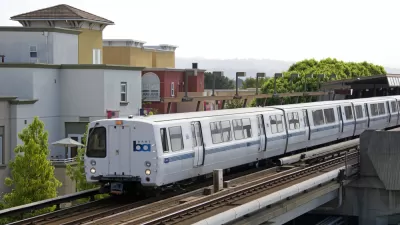
Moving more than 430,000 passengers across 107 miles of track each weekday requires a massive amount of energy, making BART one of Northern California’s top 10 power consumers. The agency has been investigating ways to obtain more of this energy from renewable sources. As part of this effort, it asked Arup to consider the potential impact of placing photovoltaic (PV) arrays on its substantial real estate holdings.
Read the full story: Can solar power fuel mass transit?
Rapid Buses To Serve Suburbs?
A local leader in the suburban Maryland/Washington DC area proposes aggressive use of "rapid buses" in dedicated lanes to accommodate growth, like other jurisdictions in the U.S.
The Party Train
Metrolink is Southern California's regional rail system linking several counties. The 15-year old system with 7 lines, 54 stations, and 388 route miles serves over 40,000 passengers in the Southland. Metrolink says its mission is "to provide the people of Southern California safe, reliable and environmentally friendly commute option." Sure, but can it also serve as an interesting venue to host a 4-year old's birthday party? One birthday boy in particular loves trains and is a fan of a popular TV series featuring trains. His mother told me that their family trips were often planned around using rail transit to get to destinations in Central and Southern California. So what better way to celebrate his birthday than to invite his friends -- accompanied by parents of course -- for a trip on a commuter train? Children that age are probably more used to birthday parties where they are entertained by clowns or magicians. Would these children, growing up in Southern California's car-centric culture be entertained at a party where the view through a train window was the main attraction?
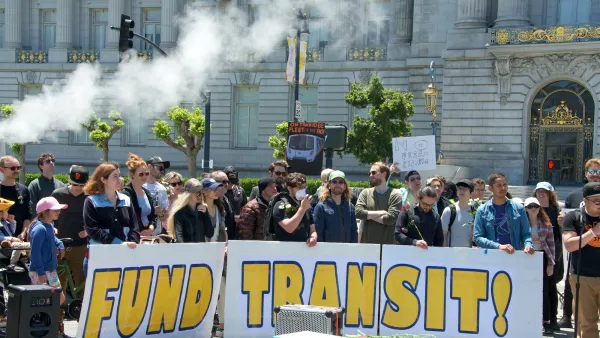
BART approves 2027 budget with no cuts, banking on November ballot measure for new funding
The Bay Area transit agency hopes to move forward without service cuts or fare increases.

Washington state to charge fee to drivers with fuel-efficient cars
Revenue from the fee will go towards supporting the state’s highways.

Illinois considers spending $1 billion in taxpayer money on data center
A quantum computing campus and data center are currently under construction in Chicago.

Trump to blast ‘hydrocarbon highway’ through ‘world’s longest art gallery’
Environmental and historic preservation groups are suing to stop the project.

Boston City Council votes to no longer mandate parking in residential developments
The Boston Zoning Commission still needs to approve the proposal.

Passengers in New York, California lift off in air taxis
Two air taxi companies have received a Special Airworthiness Market Survey Certificate, which allows them to service passengers.

MTA to upgrade subway signals for entire network by 2050
This is the first time New York City has planned to modernize subway signals in the Bronx.

FREE Course: Walkable City 1: Why Walkability?
After describing his path towards focusing on walkability as the essence of good planning, Jeff Speck marches through his five principal reasons for making more walkable places.
Reinventing Malls: Planning Alchemy—Turning Gray Fields Into Gold
The course focuses on the opportunities and imperatives that shape reinvention of mall sites.

City of Charlotte
City of Rosemead
Rutgers University, Edward J. Bloustein School of Planning and Public Policy
University of Michigan School for Environment and Sustainability (SEAS)
Hunter College, City University of New York (CUNY)
The Architects Foundation
University District Partnership