St. Louis will have electric buses running around town for a week, but that doesn't mean the city's residents should expect a massive rollout of the buses anytime soon.


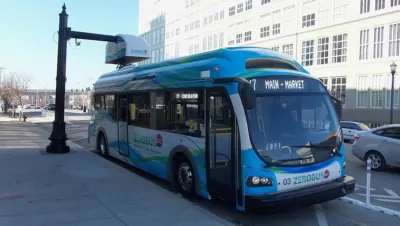
Bryce Gray reports that St. Louis' Metro Transit is test driving an electric bus built by California-based Proterra next week.
The bus "will carry passengers on the No. 99 Downtown Trolley route until Tuesday, April 11," according to Gray. "The 42-foot-long bus is capable of going 250 miles on a single charge," reports Gray.
The test is very preliminary, however. "Once the bus' one-week test run is complete…there's no timetable for a decision about 'when, or if' Metro deploys the vehicles in the future." The cost of the Proterra buses is reason to be careful in testing out the futuristic rolling stock—the electric buses cost about $850,000 each. The diesel buses currently running routes in the Metro fleet cost about $440,000. According to local transit officials, the difference would be made up over time, given that the Proterra buses operate at two-thirds of the cost of diesel buses.
Read the full story: Metro begins test driving electric bus on downtown St. Louis route
Bus Service Cut in St. Louis Again
Metro Transit has bus transit operations in St. Louis for the third time in seven months due to systemwide staff shortages.

The 'Quiet Revolution' of Zero Emission Transit Buses
More and more U.S. transit agencies are rolling out electric buses, and the recently approved federal infrastructure bill could make it easier than ever to buy zero emission electric buses.

Range Anxiety: Electric Buses Still Aren't Ready to Scale
Money intended for electric buses in Indianapolis will instead be spent on diesel buses.

Planetizen Federal Action Tracker
A weekly monitor of how Trump’s orders and actions are impacting planners and planning in America.

California plans to bury El Niño’s downpour
If the state plays its cards right, it may be able to store a billion acre-feet of El Niño’s water in aquifers.

Desperate measures: Advocates weigh draining Lake Powell to fill Colorado River
Draining the reservoir could reduce evaporation losses by a couple hundred thousand acre-feet.

Los Angeles just elected an urban planner as its mayor
Transportation analysts are optimistic that Raman will be more aggressive in addressing transit issues than Bass.

Mamdani’s pied-à-terre tax survives legal challenge
A panel of judges found that the plaintiffs failed to demonstrate injury as a result of New York City's implementation of the tax.

Eastern Nebraska is running out of electricity
Data centers and electrification are straining eastern Nebraska’s grid, throttling economic development.

FREE Course: Walkable City 1: Why Walkability?
After describing his path towards focusing on walkability as the essence of good planning, Jeff Speck marches through his five principal reasons for making more walkable places.
Reinventing Malls: Planning Alchemy—Turning Gray Fields Into Gold
The course focuses on the opportunities and imperatives that shape reinvention of mall sites.

City of Rosemead
Rutgers University, Edward J. Bloustein School of Planning and Public Policy
One Hundred Miles
University of Michigan School for Environment and Sustainability (SEAS)
Hunter College, City University of New York (CUNY)
The Architects Foundation
City of Cambridge
Montrose County
The Pocatello Development Authority