For the first time in 30 years, a crop of new clouds will enter the canon of cloud varieties recognized by meteorologists all over the world. This is also a good time to talk about climate change.



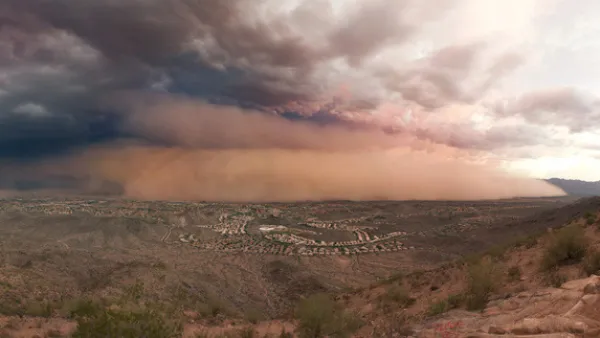
"The official International Cloud Atlas has just gained a new species: Volutus is a tube-shaped mass that rotates slowly around its horizontal axis," according to an article by Clive Cookson. The International Cloud Atlas has been the definitive reference of cloud varieties for meteorologists since 1896. The new edition is the first update to the Atlas in 30 years.
"The revised edition of the atlas, published this week by the World Meteorological Office, describes Volutus as 'an example of an undular bore'," adds Cookson of one of the additions to the Atlas sure to excite weather observers, both amateur and professional.
But wait, there's more! A citizen science movement also successfully advocated for the inclusion of the Asperitas cloud in the Atlas. Another newcomers include "Homogenitus (clouds such as aircraft contrails resulting from human activity), Flumen (beaver’s tail clouds associated with severe thunderstorms) and Flammagenitus (caused by convection over forest fires)."
The article places the addition of these new clouds into the context of conversations about climate change. Scientists "emphasise the need to understand better the central role that clouds play in weather and climate," writes Cook.
The Financial Times article might be behind a paywall for some readers. More coverage of the new edition of the International Cloud Atlas is available at treehugger, Wired, and the BBC.
Read the full story: New clouds appear on scientists’ horizons

Remembering the Weather of Winters Past
The measurable effects of climate change are a tangible reminder of trends over time that otherwise can be hard to recall.
Find Your City's 2080 Climate Change Twin
Want to know what the weather will feel like after climate change takes hold? There might be a hotter and drier place already on the planet that can offer clues.

Designing for Heat Waves
Climate change means cities around the world will have to deal with a growing number of heat waves.

Planetizen Federal Action Tracker
A weekly monitor of how Trump’s orders and actions are impacting planners and planning in America.

Eastern Nebraska is running out of electricity
Data centers and electrification are straining eastern Nebraska’s grid, throttling economic development.

Washington state to charge fee to drivers with fuel-efficient cars
Revenue from the fee will go towards supporting the state’s highways.

Instead of building new housing, LA developers are turning mansions into mega-mansions
In the richest areas, the number of houses valued at $30 million with demolition permits has skyrocketed since 2018.

Illinois considers spending $1 billion in taxpayer money on data center
A quantum computing campus and data center are currently under construction in Chicago.

As development costs rise, Boston moves to lessen affordable housing requirements
The Boston Zoning Commission and the City Council still need to approve Boston Mayor Michelle Wu’s proposed changes

FREE Course: Walkable City 1: Why Walkability?
After describing his path towards focusing on walkability as the essence of good planning, Jeff Speck marches through his five principal reasons for making more walkable places.
Reinventing Malls: Planning Alchemy—Turning Gray Fields Into Gold
The course focuses on the opportunities and imperatives that shape reinvention of mall sites.


City of Charlotte
City of Rosemead
Rutgers University, Edward J. Bloustein School of Planning and Public Policy
University of Michigan School for Environment and Sustainability (SEAS)
Hunter College, City University of New York (CUNY)
The Architects Foundation
University District Partnership
City of Cambridge
The Pocatello Development Authority