While what exact form it will take is uncertain, the idea of a circulator running a loop through Downtown Boise is gaining support.


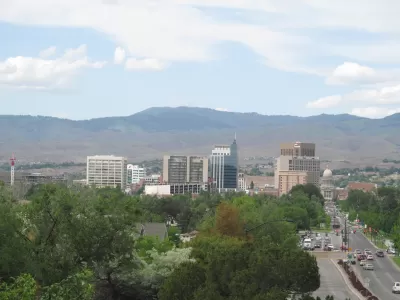
As Downtown Boise grows and parking spots become harder to find, the push is on once again to create a downtown circulator that would follow a 'T'-shaped loop, running east-west through downtown and north-south, with a connection to the Boise State University campus. George Prentice of the Boise Weekly reports that at an open house on March 14, residents had a chance to view the potential route. The biggest question may be what form the circulator takes: bus or streetcar. Prentice writes that Boise Mayor Dave Bieter was an early supporter of the streetcar option, although economic analysis shows that the cost of the streetcar loop would be five times that for a fixed-route bus system.
Most open house visitors gravitated to a chart comparing the economics of streetcars versus buses. For example, the assumption is that construction of a streetcar system might cost $111 million compared to $23 million to fund a permanent bus service on the route. Presuming there would be no fare, the assumption is that as many as 1,400 people would ride the streetcar each day with 1,100 on a bus.
Read the full story: A Reason to Ride: The New Push for a Boise Circulator

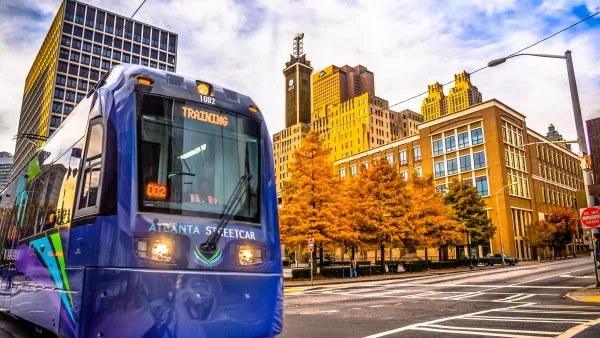
Atlanta's Nascent Streetcar Systems Begins Charging, Critics Pounce
After a stumbling start getting off the ground, proponents of Atlanta's new streetcar see hope in its future while others question further investment.
Why I Gave Up the Bus...For a Bike
In August, I moved into a high density apartment complex just 1.5 miles from my office and a five minute walk to a bus stop. One of the central advantages of the building's location was its access to alternative transportation modes. While I could park my car for "free" (the real cost is built into the lease), I was interested in keeping it parked as much as possible. Now, after nearly three months of experimentation, I'm ready to give up the bus, and the reasons are central to understanding the future of transit in the US.
VIA Clashes With San Antonio City Council Over Wireless Streetcar Plan
VIA Metropolitan Transit Company met with the city council regarding future plans involving a new streetcar line. According to Vianna Davila, "VIA must drastically change its streetcar proposal if it wants the city to help pay for the project."

Planetizen Federal Action Tracker
A weekly monitor of how Trump’s orders and actions are impacting planners and planning in America.

Amtrak, CN end decades-long dispute with eight-year agreement
The new operating agreement establishes an updated framework for the companies to work together, including processes to resolve disputes.

Judges permit Denver to divert 77,000 acre feet from the Colorado River for reservoir expansion
Overuse and climate change have caused the Colorado River’s water levels to plummet.

NYC DOT wants faster, more permanent street upgrades
The city is examining ways to build more concrete infrastructure without getting entangled in 'decades-long' projects.

'Something we’ve never seen before:' rising utility rates could strain city finances nationwide
Data centers, climate change and other factors have caused utility rates in the United States to increase by 38% since 2020.

Trump to overrule local leaders, lease millions of acres of America’s Pacific Island territories’ seafloors to mining companies
International law says that the Indigenous people of America’s territories have a right to prior and informed consent regarding projects that impact their countries.

FREE Course: Walkable City 1: Why Walkability?
After describing his path towards focusing on walkability as the essence of good planning, Jeff Speck marches through his five principal reasons for making more walkable places.
Reinventing Malls: Planning Alchemy—Turning Gray Fields Into Gold
The course focuses on the opportunities and imperatives that shape reinvention of mall sites.

Harvard University Graduate School of Design
KFH Group Inc.
Greater Baltimore Committee
The Architects Foundation
University of Cincinnati Online
The Pocatello Development Authority
The Urban Renewal Agency of the City of Pocatello