Transportation network companies cannot duplicate transit service in outlying communities, argues Ryan Young.


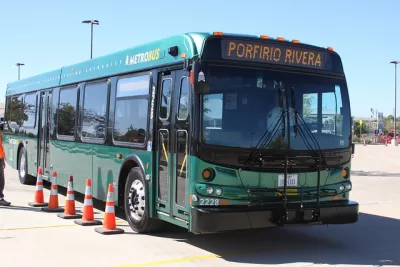
Ryan Young sees cause for concern in Austin's Connections 2025, especially in the "…plans to shift buses and resources to provide better service on transit-friendly corridors," he writes in the Daily Texan. By focusing on better serving high-traffic corridors, the focus is taken off sending buses to the harder-to-reach communities. "The trouble is that public transit is a lifeline for the people who live in these communities. If we’re getting rid of their buses, we have to be careful that whatever replaces them won’t leave residents stranded."
Connections 2025 offers alternatives to traditional buses to serve these communities like, "…flexible bus routes, car and bicycle sharing and subsidized ride-sharing," but, in Young's view, these solutions do not improve on bus transit. "It would be especially reckless to replace transit with ride-sharing... Unlike buses, private automobiles do not have spaces for wheelchairs. And ride-sharing services require smartphones and Internet subscriptions, luxuries that many who depend on transit do not have," Young writes.
Read the full story: Capital Metro must not abandon traditional buses
Light Rail and Buses and More, Oh My!
A light rail bridge proposed for Lady Bird Lake, still pre-design, is causing controversies about whether adding buses to the bridge would be too dangerous for the other non-automotive modes.
'Project Connect' Bus System Plan Underway in Austin
Austin is the latest city in the United States to undertake a massive overhaul of its bus system, designing for a high frequency grid.
Bus System Redesign Boosts Ridership in Austin
Over a year after Capital Metro in Austin overhauled its bus system design, the system is bucking national trends and achieving growth in its ridership numbers.

Planetizen Federal Action Tracker
A weekly monitor of how Trump’s orders and actions are impacting planners and planning in America.

Eastern Nebraska is running out of electricity
Data centers and electrification are straining eastern Nebraska’s grid, throttling economic development.

Move over, LA: St. Louis gears up for Olympics, invests millions in downtown redevelopment
The Missouri city will host the 2028 Olympic soccer group stage and knockout matches.

Dallas releases zoning code overhaul to officials
The drafted overhaul is over 400 pages long.

NYC renovations for dangerous, ‘mercilessly crammed’ street delayed until 2027
Construction was supposed to begin this fall.

San Diego’s Midway Rising project gets greenlight from city council
The project looks to become the largest affordable housing development in California's history.

FREE Course: Walkable City 1: Why Walkability?
After describing his path towards focusing on walkability as the essence of good planning, Jeff Speck marches through his five principal reasons for making more walkable places.
Reinventing Malls: Planning Alchemy—Turning Gray Fields Into Gold
The course focuses on the opportunities and imperatives that shape reinvention of mall sites.

City of Rosemead
Rutgers University, Edward J. Bloustein School of Planning and Public Policy
One Hundred Miles
University of Michigan School for Environment and Sustainability (SEAS)
Hunter College, City University of New York (CUNY)
The Architects Foundation
City of Cambridge
The Pocatello Development Authority
The Urban Renewal Agency of the City of Pocatello