A new framework plan for Detroit's East Riverfront District will focus more on creating public spaces than a previous version of the plan. The proposed vision for the waterfront would expand Milliken State Park and create two new parks.



John Gallagher reports on a new plan for Detroit's east waterfront. "In a bold, new, and more democratic vision unveiled Wednesday evening, city planners showed off a blueprint to create three zones of public parkland on the riverfront where once private development had been scheduled to rise," writes Gallagher.
"The city also plans to create two new Dequindre Cut-style greenways down to the riverfront from the neighborhoods north of Jefferson Avenue to ease public access to the waterfront," adds Gallagher.
The article includes a photo gallery showing images of the current condition at the eastern waterfront, as well as renderings and plan views of the proposed vision for the waterfront.
Louis Aguilar provides additional news coverage of the proposed waterfront plan, along with another set of images. Skidmore Owings and Merrill, which contracted with the Detroit RiverFront Conservancy to generate the plan, also has set up a project page to explain more of the thinking behind the proposes planning vision.
Read the full story: Detroit's riverfront plan includes a beach, more parks, fewer condos
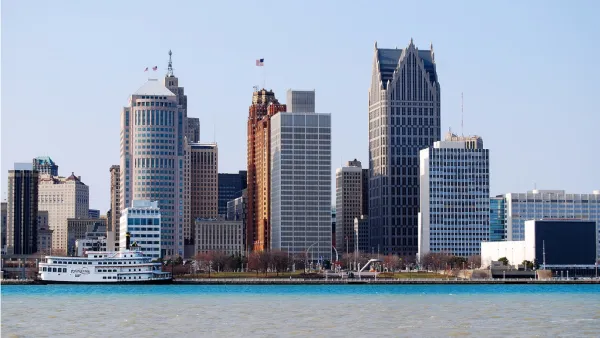
Community-Driven Designs Proposed for Detroit's West Riverfront Park
Following a plan to line the city's waterfront with redeveloped parkland, Detroit's 22-acre West Riverfront Park will incorporate concepts from a community-led design process.
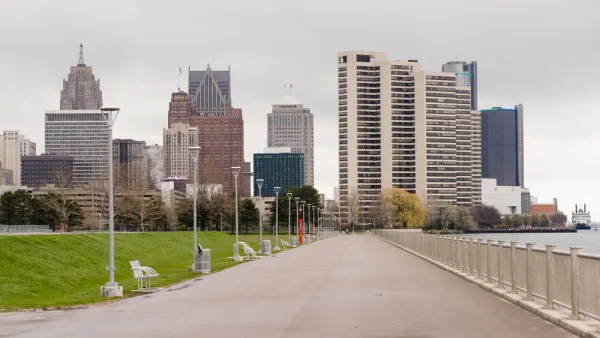
Shaping a 15-Minute City Vision for Detroit and Cleveland Using Data-Assisted Modeling
How master plans in the two cities hope to transform their historic, and historically underutilized, waterfronts.
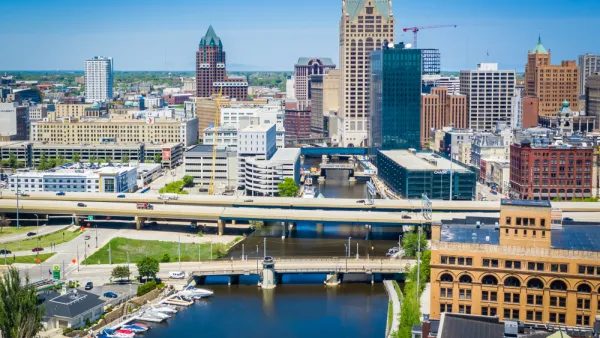
Project Team for Milwaukee's New Downtown Area Plan Takes Shape
A new plan for Milwaukee's downtown will build on a "major renaissance" in the area since the approval of the last version of the plan in 2010.

Planetizen Federal Action Tracker
A weekly monitor of how Trump’s orders and actions are impacting planners and planning in America.

Washington state to charge fee to drivers with fuel-efficient cars
Revenue from the fee will go towards supporting the state’s highways.

Illinois considers spending $1 billion in taxpayer money on data center
A quantum computing campus and data center are currently under construction in Chicago.

Did data centers change how voters cast their ballots?
Texas, Ohio, and Georgia all flipped party control. But in rural counties, the effect of local data centers was mixed.

Amtrak invests in eight new Airo trainsets
The new trainsets will begin serving passengers in 2031.

HUD to end aid for mixed-immigration-status households
The new rule is projected to impact 80,000 people, nearly half of whom are children.

FREE Course: Walkable City 1: Why Walkability?
After describing his path towards focusing on walkability as the essence of good planning, Jeff Speck marches through his five principal reasons for making more walkable places.
Reinventing Malls: Planning Alchemy—Turning Gray Fields Into Gold
The course focuses on the opportunities and imperatives that shape reinvention of mall sites.

City of Charlotte
City of Rosemead
Rutgers University, Edward J. Bloustein School of Planning and Public Policy
University of Michigan School for Environment and Sustainability (SEAS)
Hunter College, City University of New York (CUNY)
The Architects Foundation
University District Partnership