The city of St. Louis is taking the first official steps toward the ambitious Northside-Southside MetroLink proposal.



Leah Thorsen reports on the early efforts to evaluate a proposed Northside-Southside MetroLink route in St. Louis.
Early into the study, according to Thorsen, "a main focus is learning what has changed since the route last was examined in 2008" while looking for ways to "connect to the $1.75 billion National Geospatial-Intelligence Agency headquarters set to be built just northwest of downtown…"
Thorsen quotes Dan Meyers, a project manager with AECOM, which is leading the consulting team for the study, to explain the initial steps of the study. One early benchmark to look for is a community engagement plan—expected to be implemented as early as April or May.
Thorsen also describes the current, speculative vision for the project: "A 31-mile route from north St. Louis County through the city and into south St. Louis…with a pricetag estimated at $2.2 billion."
Planetizen last checked in with the Northside-Southside project in June 2016, when the long-serving mayor of the city, Francis Slay, expressed strong support for the project.
Read the full story: MetroLink study to focus on justifying project, showing strong local financial commitment
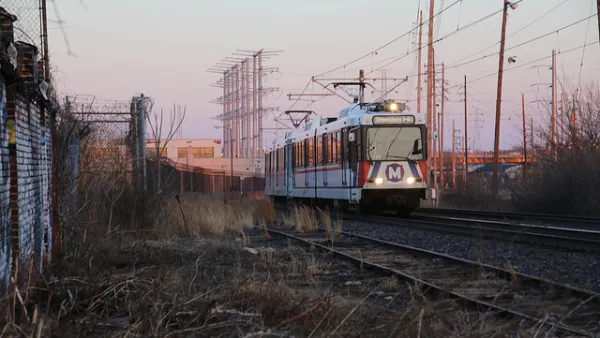
With Mayoral Support—What's Next for Proposed MetroLink Extension in St. Louis
The long-time mayor of St. Louis has announced his top priority for his final year in office, and it's good news for transit advocates.
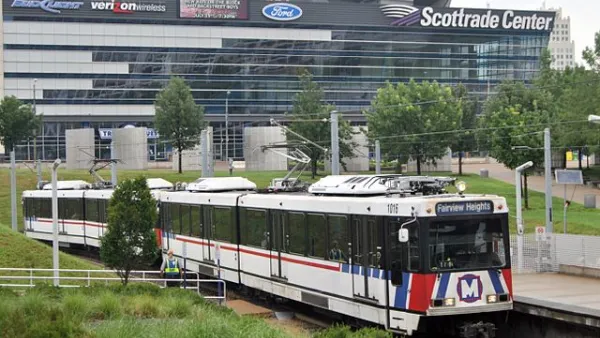
Crime, Cheap Gas, Declining Population: A Cocktail for Decreased Transit Ridership
St. Louis transit planners are evaluating the reasons behind a decline in transit use as the Metro Transit system prepares its first light expansion in years.
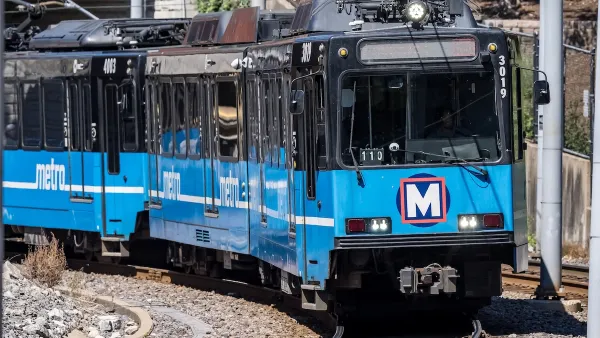
St. Louis Metro to test if single-car trains can reduce operating costs, maintain rider satisfaction
The pilot program will run from October to spring 2027, and begin with one single-car train operating on Metrolink’s Red and Blue lines.

Desperate measures: Advocates weigh draining Lake Powell to fill Colorado River
Draining the reservoir could reduce evaporation losses by a couple hundred thousand acre-feet.

Eastern Nebraska is running out of electricity
Data centers and electrification are straining eastern Nebraska’s grid, throttling economic development.
Malls are becoming the midtowns of the future
Mall and office park redevelopments are a generational opportunity to create new nodes of urbanity.

NYC breaks ground on anti-flooding infrastructure project
New York City's new system will reduce stormwater flows to local sewers by 90%.

One Kentucky town’s secret to affordable housing
The Smoketown Community Land Trust has already built seven affordable homes for community members.

Houston gains petal-shaped cooling infrastructure to make streets more ‘delightful’
The city has installed the pavilions along 15 blocks in Houston.

FREE Course: Walkable City 1: Why Walkability?
After describing his path towards focusing on walkability as the essence of good planning, Jeff Speck marches through his five principal reasons for making more walkable places.
Reinventing Malls: Planning Alchemy—Turning Gray Fields Into Gold
The course focuses on the opportunities and imperatives that shape reinvention of mall sites.

City of Rosemead
Rutgers University, Edward J. Bloustein School of Planning and Public Policy
One Hundred Miles
University of Michigan School for Environment and Sustainability (SEAS)
Hunter College, City University of New York (CUNY)
The Architects Foundation
City of Cambridge
Montrose County
The Pocatello Development Authority