Breezewood Pennsylvania is home to a traffic bottle neck on the I-70, and could be a target of Trump's promised infrastructure spending.


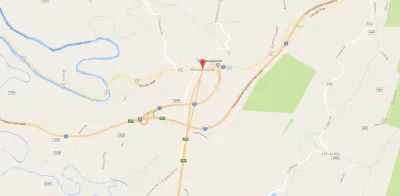
When Interstate 70 passes through Breezewood, Pennsylvania, it starts to look like a plate of spaghetti. There's a two-mile loop through the town that could be eliminated with a simple interchange, but if it were, that would also eliminate a large source of income for the city. The issue has been a source of a lot of frustration, "Many other drivers vent similar — often profane — anger and confusion about this notorious choke point," Charlie Savage Reports for the New York Times.
Savage suggests that eliminating this frustration could be a target for some of the infrastructure budget that the Trump Administration promised during the campaign. "The trucking industry would save as much as 142,362 hours in driver time and $9 million in operating costs every year. Add to that the time and money savings for car drivers, to say nothing of eliminating the unnecessary carbon dioxide emissions from the fuel that both types of vehicles burn to travel the extra distance," Savage writes. There have been many proposals in the past to put in the interchange but past politicians couldn't overcome resistance from the stakeholders that profit from the highway slowdown in the city of Breezewood, whether or not the Trump Administration will take on the challenge is yet to be seen.
FULL STORY: As Trump Vows Building Splurge, Famed Traffic Choke Point Offers Warning

Trump to allow infrastructure along highways, railways in bid to bypass reviews
By building lines close to existing infrastructure, Trump aims to lower costs and bypass environmental oversight and opposition from local communities.
Top Republicans Encourage Governors to Ignore FHWA Guidance
Senators McConnell and Capito reject the administration's efforts to steer federal funds to infrastructure projects that prioritize road maintenance and transit and pedestrian improvements over new road construction.
Opinion: America's Infrastructure Doesn't Need a Federal Spending 'Binge'
Despite alarming claims about the nation's roads and bridges, a column in the Chicago Tribune argues that the administration's proposed infrastructure spending doesn't match actual needs.

Planetizen Federal Action Tracker
A weekly monitor of how Trump’s orders and actions are impacting planners and planning in America.

The state-sanctioned urbicide of Austin
People don’t kill cities. Freeways do.

US to reduce Colorado River water deliveries to Mexico
A new Colorado Treaty amendment reduces Mexico’s Colorado River water allocation by 250,000 acre feet.

5 New England states march closer to 800 megawatt wind energy project
Securing federal approval for the project may be complicated under the Trump administration, which has historically been hostile towards domestic wind power.

Baltimore to break ground on $50 million Transit Priority Project
The project will bring faster bus trips, safer streets and better bike connections to Baltimore.

Airbnb launches $250 million 'last-dollar financing' housing accelerator, makes first investment in Austin
The company will put $6.4 million towards affordable housing development in Texas’ capital.

FREE Course: Walkable City 1: Why Walkability?
After describing his path towards focusing on walkability as the essence of good planning, Jeff Speck marches through his five principal reasons for making more walkable places.
Reinventing Malls: Planning Alchemy—Turning Gray Fields Into Gold
The course focuses on the opportunities and imperatives that shape reinvention of mall sites.

Eagle County Government
Harvard University Graduate School of Design
Nashville Planning Department
The Architects Foundation
University of Cincinnati Online
The Pocatello Development Authority
The Urban Renewal Agency of the City of Pocatello
Journal of the American Planning Association