It's been 500 years since Thomas More penned his classic Utopia. With the benefit of hindsight, Los Angeles area planner, Jodie Sackett, reviews some of the key ingredients More believed necessary for a utopian society.


Multiple mid-sized cities, equally spaced about a days walk apart, with a population of about 5.5 million distributed over an island of a size halfway between Ireland and Cuba—these were some of the characteristics of Thomas More's Utopia. Los Angeles County planner Jodie Sacket takes a look back at some of More's ideas with a modern eye. 2016 marked the 500th anniversary of More's Utopia, and while some of his concepts were, well, utopian, Utopia is an historically significant work of which planners should have some knowledge, at least for context and background, and understanding the evolution of planning theory; or as noted by Sackett:
"As urbanists, city-thinkers and city-dwellers, do we look at cities in the same way today? It’s a worthy thought."
For Sackett's full review, please visit the source article.
Read the full story: What makes a Utopia? – a review of Thomas More’s classic on its 500th anniversary
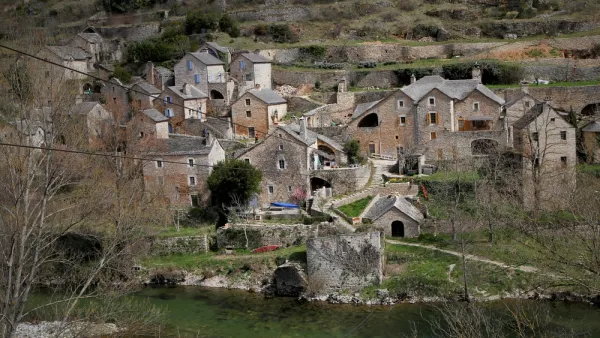
Planning Utopia: Revisiting Thomas More's Classic
In this second installment of a three-part review of Thomas More's Utopia in its 500th anniversary year, L.A. area planner Jodie Sackett looks at More's ideas for planning a Utopian city. Do More's ideas have current relevance?

Land Use: Chasing Utopia, 2025?
History has taught us the risks of undervaluing the power of planning decisions. Overvaluing them might be just as dangerous.
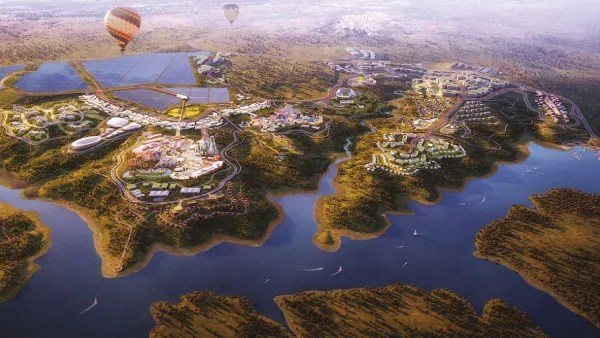
New ‘City’ Elysium Planned in Spain
The development proposes a from-scratch sustainable community built on brand new land at the edge of a reservoir.

Desperate measures: Advocates weigh draining Lake Powell to fill Colorado River
Draining the reservoir could reduce evaporation losses by a couple hundred thousand acre-feet.

Eastern Nebraska is running out of electricity
Data centers and electrification are straining eastern Nebraska’s grid, throttling economic development.

Malls are becoming the midtowns of the future
Mall and office park redevelopments are a generational opportunity to create new nodes of urbanity.

NYC breaks ground on anti-flooding infrastructure project
New York City's new system will reduce stormwater flows to local sewers by 90%.

One Kentucky town’s secret to affordable housing
The Smoketown Community Land Trust has already built seven affordable homes for community members.

Houston gains petal-shaped cooling infrastructure to make streets more ‘delightful’
The city has installed the pavilions along 15 blocks in Houston.

FREE Course: Walkable City 1: Why Walkability?
After describing his path towards focusing on walkability as the essence of good planning, Jeff Speck marches through his five principal reasons for making more walkable places.
Reinventing Malls: Planning Alchemy—Turning Gray Fields Into Gold
The course focuses on the opportunities and imperatives that shape reinvention of mall sites.

City of Rosemead
Rutgers University, Edward J. Bloustein School of Planning and Public Policy
One Hundred Miles
University of Michigan School for Environment and Sustainability (SEAS)
Hunter College, City University of New York (CUNY)
The Architects Foundation
City of Cambridge
Montrose County
The Pocatello Development Authority