Chariot shuttle service, recently acquired by Ford Motor Company, may soon be a more formidable competitor for San Francisco's public transit provider, Muni, due to an expansion to 150 vans. Expect new routes, five-minute headways, and $4 rides.


"The commuter shuttle service, recently acquired by Ford Motor Co., is adding 50 new vans to its fleet, bringing its total to 150, and hiring 75 additional drivers," reports Carolyn Said for the San Francisco Chronicle.
This will allow us to address a lot of the pent-up demand for our services, and bring in people who’ve been driving cars or taking ride-sharing,” said Ali Vahabzadeh, Chariot CEO and founder.
In addition to adding routes, "(t)he additions will nudge Chariot’s frequency to every four or five minutes during peak commute hours...," adds Said.
"The 2-year-old company, backed by $3 million in venture capital, gives thousands of rides a day at an average fare of $4, Vahabzadeh said," reported Said and David R. Baker in September, when Ford announced its acquisition of Chariot and collaboration with Motivate, the bike sharing company, to expand and rename Bay Area Bike Share.
About a fifth of riders use Chariot to complement public transit, going to or from BART, Caltrain or ferries, for instance. While it’s experienced healthy growth, the Ford deal will vault it to a new level, Vahabzadeh said.
Crowdsourcing and Crowdfunding
According to its website, Chariot "crowdsource(s) future routes and pickup/dropoff stops by learning home and work address from users like you."
Then, upon reaching a critical mass in a neighborhood, we ask you and your neighbors to crowdfund the new route’s launch by reserving your first Chariot pass. When we reach the target number of riders, Chariot launches the new route within days.
Withstood competition from other commute startups
Chariot's expansion speaks well for the service, considering that it has outlasted three other private, for-profit transit operations that served the public, assuming you had a smart phone and a credit card. Loup, Leap and Nightschool were unable to survive.
Chariot's 15-passenger shuttle vans, all Ford Transit Wagons, are not be confused with the much larger and controversial 'tech shuttles,' aka Google Buses, that are seen as disruptive to neighborhoods and, rightly or wrongly, have been associated with displacement. While they perform a regional transit function, they do not serve the public, as they shuttle tech company employees from their San Francisco homes to their Silicon Valley workplaces.
Competition for Muni?
Chariot has the potential to siphon off more riders from San Francisco Muni buses, light rail, streetcars, and cable cars (well, maybe not the latter). But could that be good for Muni?
Some experts say commuter services like Chariot could ease budget strains if they reduce the amount of public transit needed. “We’re much better off having the private sector involved (in commuter transportation) because public transit services require so much subsidizing,” said Daniel Chatman, a UC Berkeley city planning professor who studies transit. “Not too many public transit systems make a profit or even pay for themselves.”
Financially, the spread between private and public transit rides appears to be narrowing. Said writes that Chariot hopes to get "the cost closer to $3 per ride." On January 1, farebox tickets on Muni increase by a quarter to $2.50 a ride, though Clipper fares remain at $2.25.
Expansion beyond San Francisco
Chariot will be expanding to serve the Austin, Texas market, reported Greg Gardner of the Detroit Free Press in October.
Austin is an interesting market for newer ride-hailing companies because the two largest players, Uber and Lyft, withdrew after the city passed an ordinance requiring ride-hailing companies to fingerprint drivers and conduct criminal background checks [and voters rejected a referendum to reverse the ordinance].
Ford has said Chariot will be serving at least five cities by late 2017.
Hat tip to Metropolitan Transportation Commission, News Headlines.
FULL STORY: Chariot to add 50 vans, increase shuttle frequency, add routes

On Demand Shuttle Operator to Cease Operations in Nine Cities
San Francisco-based shuttle operator Chariot, acquired by Ford Motor Company in 2016, will end its operations by March in the San Francisco Bay Area, Los Angeles, Seattle, Austin, New York, Columbus, Detroit, Denver, and London.
Bay Area Bike Share Renamed for New Sponsor: An Auto Company
The new, Detroit-based sponsor will help pay for a ten-fold expansion of the Bay Area's regional bike share program coming this spring and a new Palo Alto program. Low income residents will be offered discounted rates to join Bay Area Bike Share.
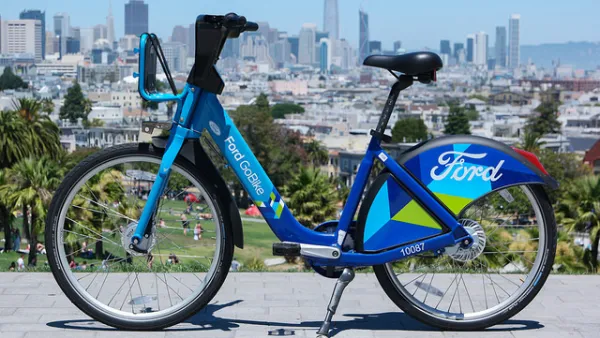
Dockless vs. Docking Bikeshare Showdown in San Francisco
When Ford GoBike took over Bay Area Bike Share last year and promised to expand the number of bikes ten-fold, they entered into an exclusivity contract with San Francisco. So why is the city going to issue a permit to a competitor?

The state-sanctioned urbicide of Austin
People don’t kill cities. Freeways do.

US to reduce Colorado River water deliveries to Mexico
A new Colorado Treaty amendment reduces Mexico’s Colorado River water allocation by 250,000 acre feet.

New Jersey’s second-largest city bans standalone data centers
Jersey City will continue to allow co-location facilities, such as those meant for research institutions that store their own data.

Amtrak not solely to blame for New Jersey commuter rail's unreliability, report finds
A new study from the Garden State Initiative found that NJ Transit’s budget grew 20% across a 4 year period, but reliability declined significantly over the same period.

EPA erases limits on planet-warming pollution from power plants
Under Monday’s plan, power plants would still have some limits on how much mercury, arsenic and other contaminants they can emit.

Phoenix announces new on-demand transit service, more frequent RAPID buses
Both new services will launch in October, and are part of Phoenix's Project Effective Access Solutions for Easing Congestion.

FREE Course: Walkable City 1: Why Walkability?
After describing his path towards focusing on walkability as the essence of good planning, Jeff Speck marches through his five principal reasons for making more walkable places.
Reinventing Malls: Planning Alchemy—Turning Gray Fields Into Gold
The course focuses on the opportunities and imperatives that shape reinvention of mall sites.

Eagle County Government
Harvard University Graduate School of Design
Nashville Planning Department
The Architects Foundation
University of Cincinnati Online
The Pocatello Development Authority
The Urban Renewal Agency of the City of Pocatello
Journal of the American Planning Association