Study finds people walk more in denser cities with more parks no matter what their country of origin.



Walkable cities really do get people walking. According to a cross sectional study of cities around the world found that, "The biggest design factors affecting the amount of 'moderate to vigorous intensity physical activity,' including walking, were: residential density, park and public transport density, and intersection density," writes Charlie Sorrel in an article for Fast Coexist.
The study, which was carried out in 14 cities sought to, "determine whether or not the cities' layouts themselves were the reason for increased health, as opposed to different lifestyles in different countries," Sorrel writes. The researches found that in cities as different as Baltimore and Bogota, "Dense, mixed-use city streets, with high walkability and ready access to good public transit: We've heard those criteria before. But this study is important because it shows that these factors lead to better public health independent of the economic status of the city or the cultural differences in different countries."
Read the full story: The Well-Designed City Is A Healthy City, All Over The World


Can Density Prevent Diabetes?
In Australia, a new study will determine the best ways to make high-density developments healthy places to live.
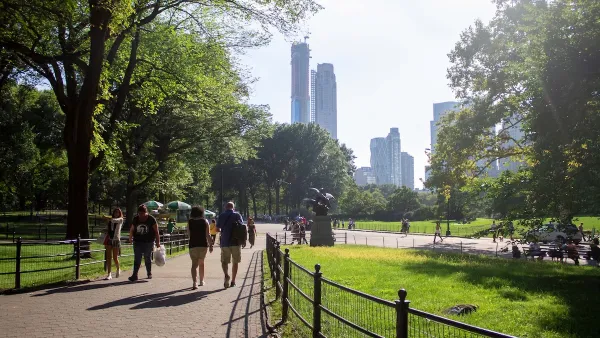
Green Spaces Benefit Neighborhoods—When Residents can Reach Them
A study comparing green space and walkability scores found that, without effective access to local parks, residents of greener neighborhoods don’t reap the health benefits.
A 10-Minute Walk to a Park for Your Health and Well-Being
The “10-Minute Walk Campaign” is a nationwide movement to ensure that everyone has safe access to a quality park or green space within a 10-minute walk. In the midst of a pandemic, it is especially important now to have a park close to home.

Planetizen Federal Action Tracker
A weekly monitor of how Trump’s orders and actions are impacting planners and planning in America.

Amtrak, CN end decades-long dispute with eight-year agreement
The new operating agreement establishes an updated framework for the companies to work together, including processes to resolve disputes.

Judges permit Denver to divert 77,000 acre feet from the Colorado River for reservoir expansion
Overuse and climate change have caused the Colorado River’s water levels to plummet.

Boston has spent millions making the Green Line more accessible — and there’s no end in sight
While the city has invested millions into expanding and adding platforms to the Green Line to make it more accessible, new train cars set to arrive next year will be too tall for disabled passengers to board without raising the current platforms.

Idaho may see an 18% drop in federal surface transit funding — the largest estimated cut in the US
Transit systems in rural communities are much more reliant on federal funding to provide their services.

How ‘post-disaster gentrification’ alters neighborhoods after natural calamities
After hurricanes, fires or other calamities, the original residents of a community are often replaced by younger, wealthier residents.

FREE Course: Walkable City 1: Why Walkability?
After describing his path towards focusing on walkability as the essence of good planning, Jeff Speck marches through his five principal reasons for making more walkable places.
Reinventing Malls: Planning Alchemy—Turning Gray Fields Into Gold
The course focuses on the opportunities and imperatives that shape reinvention of mall sites.

City of Wisconsin Rapids
Harvard University Graduate School of Design
KFH Group Inc.
The Architects Foundation
University of Cincinnati Online
The Pocatello Development Authority
The Urban Renewal Agency of the City of Pocatello