A proposal to add billboard advertisements to a pair of city-owned buildings come at a time when residents, and the federal government, are already concerned about the proliferation of billboards in the city.


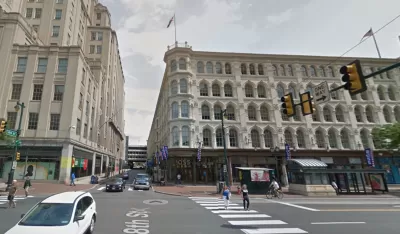
"Philadelphia is looking to cash in on some of its centrally located government real estate, with billboards proposed for the likes of Apple and Aldo on two of its public office buildings," reports Jabob Adelman. The buildings in question are the Municipal Services Building at 1401 John F. Kennedy Boulevard and the One Parkway Building at 1515 Arch Street.
According to Adelman, the city has seen a wave of new digital billboards attached to development projects along East Market Street. As explained in an article by Inga Saffron from earlier in October, the digital billboards along East Market Street were made possible by a 2011 ordinance that designated the street a "special advertising district."
The ads on the two city-owned buildings were made possible by a May 2013 bill sponsored by City Council President Darrell L. Clarke. "A Council consultant estimated at the time that the city could bring in $8 million from advertising on public buildings, bus shelters, and trash trucks," explains Adelman.
A key point made by both Adelman and Saffron is the role of the Penn Department of Transportation in regulating billboards. The Federal Highway Administration even ordered "that control of those large billboards and digital displays be returned to the Pennsylvania Department of Transportation, saying the city had not been responsive to questions about enforcement," according to Adelman. Claudia Vargas reported on the Federal Highway Administration's action in September.
Read the full story: Billboards pitched for Philly municipal office buildings amid outdoor ad boom

Supreme Court Case Could Transform Sign Regulations
If the Supreme Court upholds a lower court decision, cities could lose a long-standing right to regulate 'off-premises' billboards.
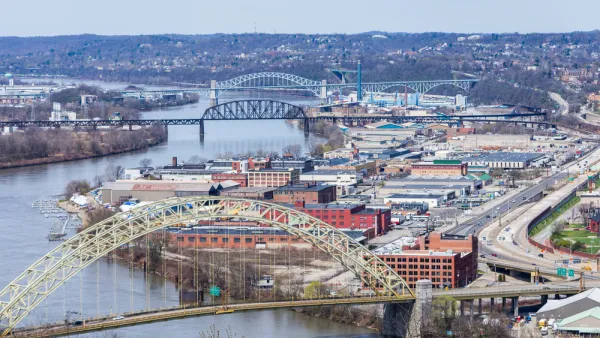
Pennsylvania to Shift Funding from Local Roads to Interstate Highways
To prevent losing funding if the state's interstate highways fall below new federal standards, Pennsylvania is rushing to change its capital investments plans.
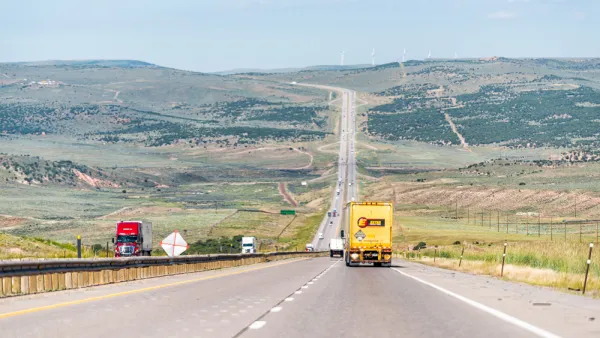
Wyoming Legislation Would Add Tolls to Interstate 80
A new bill would grant the Wyoming Transportation Commission the authority to impose tolls on all lanes of over 400 miles of I-80 to fund infrastructure needs on the roadway.

Planetizen Federal Action Tracker
A weekly monitor of how Trump’s orders and actions are impacting planners and planning in America.

Eastern Nebraska is running out of electricity
Data centers and electrification are straining eastern Nebraska’s grid, throttling economic development.

Study reveals best places in the U.S. for cycling, walking
New research from Streetlight Data examines bicycle and pedestrian miles per capita in the 100 largest U.S. cities by population.

Officials look to alter BART extension as price goes through the roof
Tariffs and the war with Iran are behind the rising cost.

To power data centers, Utah company may build hundreds of nuclear reactors on state land
In its permit application, Valar asked for the county to confirm that changes within its outlined plan would still be covered by the permit.

San Antonio is using environmental review to stall ICE detention center
San Antonio sued last month to pause work on the new detention center until the federal government studied its effect on the surrounding area.

FREE Course: Walkable City 1: Why Walkability?
After describing his path towards focusing on walkability as the essence of good planning, Jeff Speck marches through his five principal reasons for making more walkable places.
Reinventing Malls: Planning Alchemy—Turning Gray Fields Into Gold
The course focuses on the opportunities and imperatives that shape reinvention of mall sites.

City of Charlotte
City of Rosemead
Rutgers University, Edward J. Bloustein School of Planning and Public Policy
University of Michigan School for Environment and Sustainability (SEAS)
Hunter College, City University of New York (CUNY)
The Architects Foundation
City of Cambridge
The Pocatello Development Authority
The Urban Renewal Agency of the City of Pocatello