A look at Parkchester, one of four planned communities built by the Metropolitan Life Insurance Company in New York City, circa 1940s. The complex includes over 12,000 rental and ownership apartments, located near the #6 subway.


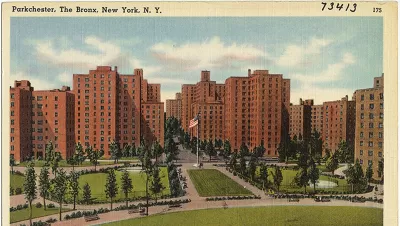
"Middle-class New Yorkers have looked to Parkchester (a 129-acre planned community in the eastern Bronx), for reasonably priced housing ever since the Metropolitan Life Insurance Company (MetLife) completed the complex in the early 1940s," writes Vera Haller, a journalism professor at Baruch College (CUNY), in the "Living In: The inside scoop on New York City neighborhoods and beyond" section of The Times.
The Parkchester complex offers studios, one-, two- and three-bedroom apartments split between sales and rentals. While all 12,271 units in the complex are condominiums, many owners rent them out. A block of 6,382 condos is held by an investor partnership that rents out units through the Parkchester Preservation Management company.
What You’ll Pay
[Ryan Moorehead, the chief executive of Parkchester Preservation Management] said studios generally rent for $975 a month, one-bedrooms for $1,240, two-bedrooms for $1,595 and three-bedrooms for $1,890....
[Felipa Manaiza, a saleswoman for Parkchester Bronx Realty, who is also a resident] said one-bedroom condos begin in the low $100,000s and go up to $130,000; two-bedroom condos range from $140,000 to $180,000; and three-bedroom units from $165,000 to $210,000.
The complex, comprised of 171 brick buildings, most of which are eight or 13 stories in height, has a density of roughly 95 units per acre. The population totals about 41,000 residents.
The leafy neighborhood looks remarkably like Stuyvesant Town and Peter Cooper Village, located on the east side of Manhattan between 14th and 23rd Street, for good reason. Both were developed by MetLife in the same decade, along with the Riverton Houses in Harlem.
Past racial segregation and current demography
"Until 1968, only whites received leases, according to a history of the neighborhood on the website of Parkchester Preservation Management," adds Haller. Wikipedia indicates that MetLife applied the same racially exclusionary policy applied to their other properties: Stuyvesant Town–Peter Cooper Village, Parkfairfax in Virginia, Parkmerced in San Francisco, and Park La Brea in Los Angeles. Riverton Houses served a "largely served an African American population."
Today, whites are now a minority.
"According to the 2009-13 American Community Survey of the Census, 45.6 percent of Parkchester’s residents identify themselves as black or African-American, 33.7 percent as Hispanic, 15.3 percent as Asian and 3.6 as percent white," notes Haller.
Mixed-use
The heart of Parkchester lies in the Aileen B. Ryan Oval, formerly called the Metropolitan Oval, where residents relax on benches as they gaze at the water-spouting nymphs in the plaza’s central fountain.
Stores and restaurants line the complex’s two main streets, Metropolitan Avenue and Unionport Road.
The "Parkchester neighborhood" also includes streets adjacent to the complex "with a mix of attached two-story brick row houses and four-story apartment houses...as well," adds Verra. [See attached map in article indicating streets that extend the border of the neighborhood.]
Transit
The neighborhood is served by two stops on the No. 6 subway train: Castle Hill Ave. and Parkchester, and the Bronx M6 express bus.
In addition, "the Metro-North Railroad is planning a Parkchester stop," notes Haller. "The Metropolitan Transportation Authority expects to complete environmental and federal reviews by 2017."
Art
"At first glance, Parkchester’s brick buildings look plain, but closer inspection shows the builders adorned them with some 500 terra-cotta statues, high on corners and over doorways — animals, human figures and mythical characters," adds Haller.
Note the 13-photo slideshow by Danny R. Peralta of The Times.
Read the full story: Parkchester, the Bronx, Working as Planned
World Record Sale for Manhattan Real Estate, Again
The $5.46 billion sale last October for the private 83 acres of Stuyvesant Town and Peter Cooper Village barely topped the prior world record set for the same property in 2006 and preserved 5,000 apartments for middle income renters.
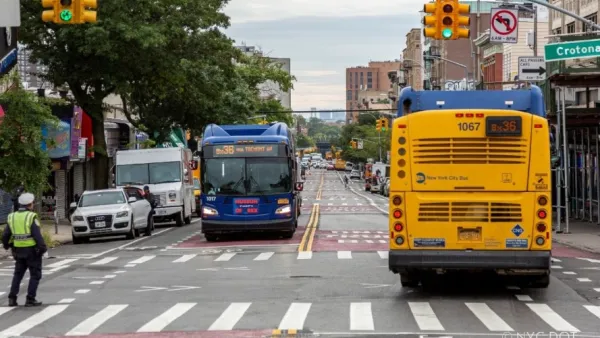
Buses travel at 5mph along this route in NYC. The Bronx's first-ever busway looks to change that
Prior to the busway, buses on the Bx36 route traveled as slowly as 5 miles per hour.
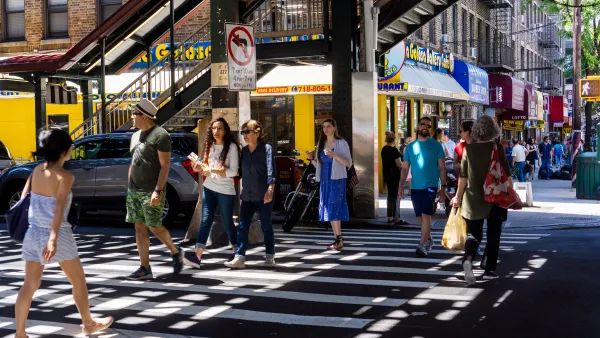
NYC needs 700,000 new homes to resolve housing crisis, report states
The report gave every neighborhood a non-binding development target.

Planetizen Federal Action Tracker
A weekly monitor of how Trump’s orders and actions are impacting planners and planning in America.

California plans to bury El Niño’s downpour
If the state plays its cards right, it may be able to store a billion acre-feet of El Niño’s water in aquifers.

Desperate measures: Advocates weigh draining Lake Powell to fill Colorado River
Draining the reservoir could reduce evaporation losses by a couple hundred thousand acre-feet.

Los Angeles just elected an urban planner as its mayor
Transportation analysts are optimistic that Raman will be more aggressive in addressing transit issues than Bass.

Mamdani’s pied-à-terre tax survives legal challenge
A panel of judges found that the plaintiffs failed to demonstrate injury as a result of New York City's implementation of the tax.

Eastern Nebraska is running out of electricity
Data centers and electrification are straining eastern Nebraska’s grid, throttling economic development.

FREE Course: Walkable City 1: Why Walkability?
After describing his path towards focusing on walkability as the essence of good planning, Jeff Speck marches through his five principal reasons for making more walkable places.
Reinventing Malls: Planning Alchemy—Turning Gray Fields Into Gold
The course focuses on the opportunities and imperatives that shape reinvention of mall sites.

City of Rosemead
Rutgers University, Edward J. Bloustein School of Planning and Public Policy
One Hundred Miles
University of Michigan School for Environment and Sustainability (SEAS)
Hunter College, City University of New York (CUNY)
The Architects Foundation
City of Cambridge
Montrose County
The Pocatello Development Authority