The encyclical "Laudato si: On the Care of Our Common Home" might have scored public relations points among environmentalists last year, but according to a new study, it didn't score any points with Catholics or the broader U.S. population.


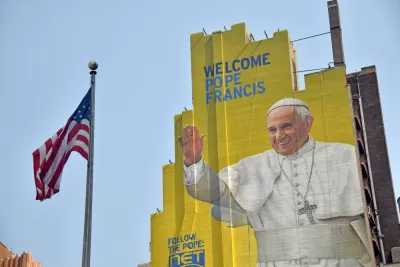
Sam Wood writes: "Pope Francis’s call last year for 'swift and unified global action' to reverse climate change fell largely on deaf ears and closed minds, according to a study published Monday, and may indicate that in the U.S. politics holds stronger sway on this topic than religious authority."
The study, published by researchers at the Annenberg Public Policy Center at the University of Pennsylvania, "speaks to the relative power of politics and religion in shaping climate change opinions," according to the conclusion presented in the paper. The researchers even went so far as to argue that the move "backfired" by "devaluing the Pope's credibility on climate change" among Catholics.
Pope Francis released the encyclical "Laudato si: On the Care of Our Common Home" to immediate praise among environmentalists and planners in June 2015. It's worth noting that among the outpouring of media attention granted to Pope Francis's encyclical, Ben Adler predicted that the message would likely fall on deaf ears in the United States and around the world.
Read the full story: Penn study: Pope's plea for climate action 'backfired'
No Papal Blessing for Cap-And-Trade
Governments must take correction actions to address climate change, warned Pope Francis in his June 18 encyclical, but cap-and-trade, which places a price on carbon emissions but can lead to speculation, is not one of them.
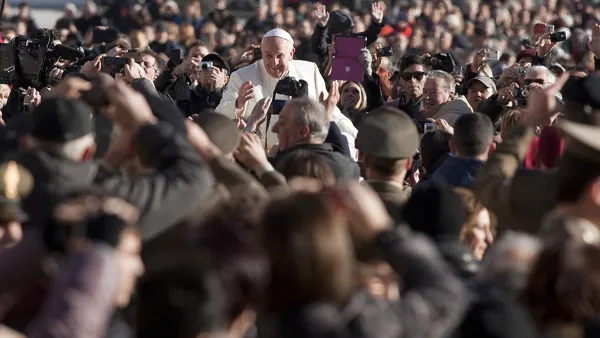
Pope Francis Taps Planners to Help Solve Climate Change
Pope Francis's unprecedented focus on climate change and the environment includes strong messages for planners and designers of the built environment.
Gov. Jerry Brown: Committed to Fighting Climate Change
Reporting from a two-day conference in Toronto where states and provinces organized to tackle climate change in advance of a UN conference, political reporter Chris Megerian profiles Gov. Brown's climate change commitment in five articles.

Planetizen Federal Action Tracker
A weekly monitor of how Trump’s orders and actions are impacting planners and planning in America.

Washington state to charge fee to drivers with fuel-efficient cars
Revenue from the fee will go towards supporting the state’s highways.

Illinois considers spending $1 billion in taxpayer money on data center
A quantum computing campus and data center are currently under construction in Chicago.

Did data centers change how voters cast their ballots?
Texas, Ohio, and Georgia all flipped party control. But in rural counties, the effect of local data centers was mixed.

Amtrak invests in eight new Airo trainsets
The new trainsets will begin serving passengers in 2031.

HUD to end aid for mixed-immigration-status households
The new rule is projected to impact 80,000 people, nearly half of whom are children.

FREE Course: Walkable City 1: Why Walkability?
After describing his path towards focusing on walkability as the essence of good planning, Jeff Speck marches through his five principal reasons for making more walkable places.
Reinventing Malls: Planning Alchemy—Turning Gray Fields Into Gold
The course focuses on the opportunities and imperatives that shape reinvention of mall sites.

City of Charlotte
City of Rosemead
Rutgers University, Edward J. Bloustein School of Planning and Public Policy
University of Michigan School for Environment and Sustainability (SEAS)
Hunter College, City University of New York (CUNY)
The Architects Foundation
University District Partnership