Pope Francis's unprecedented focus on climate change and the environment includes strong messages for planners and designers of the built environment.


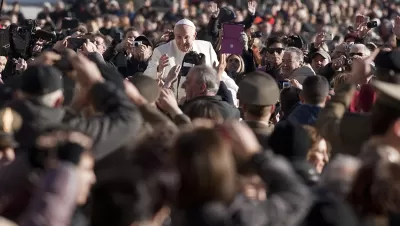
"Pope Francis on Thursday called for a radical transformation of politics, economics and individual lifestyles to confront environmental degradation and climate change, blending a biting critique of consumerism and irresponsible development with a plea for swift and unified global action," reports Jim Yardley and Laurie Goodstein in The New York Times.
Following the initial release of the encyclical, several planning and urbanism media outlets picked up on challenges offered to planners and designers of the built environment embedded in the message.
Andrew Stokols writes an article for TheCityFix that calls Pope Francis "the first urban pope" as well as "the first environmentalist pope." Stokols focuses especially on a passage from Chapter 1 (also titled "What is Happening to Our Common Home") of the encyclical, which reads:
"Nowadays, for example, we are conscious of the disproportionate and unruly growth of many cities, which have become unhealthy to live in, not only because of pollution caused by toxic emissions but also as a result of urban chaos, poor transportation, and visual pollution and noise. Many cities are huge, inefficient structures, excessively wasteful of energy and water. Neighbourhoods, even those recently built, are congested, chaotic and lacking in sufficient green space. We were not meant to be inundated by cement, asphalt, glass and metal, and deprived of physical contact with nature."
Writing for Next City, Anna Clark's take on the encyclical is Pope Francis's challenge to planners to build better cities for the poor. Clark focuses on a different passage from the same chapter:
"In some places, rural and urban alike, the privatization of certain spaces has restricted people’s access to places of particular beauty….In others, ‘ecological’ neighbourhoods have been created which are closed to outsiders in order to ensure an artificial tranquillity. Frequently, we find beautiful and carefully manicured green spaces in so-called ‘safer’ areas of cities, but not in the more hidden areas where the disposable of society live."
For the California Planning & Development Report, Josh Stephens describes Pope Francis as one of the world's foremost proponents of smart growth. Stephens focuses on a different chapter, titled "Ecology of Daily Life", which discusses the importance of communal living in cities that can asphyxiate citizens with overstimulation.
Finally for Grist, Ben Adler doubts that Pope Francis's position will have any impact on the political realities of climate change.
Read the full story: Pope Francis, in Sweeping Encyclical, Calls for Swift Action on Climate Change

In the U.S., Climate Politics Trump the Pope's Message
The encyclical "Laudato si: On the Care of Our Common Home" might have scored public relations points among environmentalists last year, but according to a new study, it didn't score any points with Catholics or the broader U.S. population.
No Papal Blessing for Cap-And-Trade
Governments must take correction actions to address climate change, warned Pope Francis in his June 18 encyclical, but cap-and-trade, which places a price on carbon emissions but can lead to speculation, is not one of them.

USDOT Launches Climate Adaptation Plan
The plan outlines the department’s key priorities in building resilient infrastructure and ensuring environmental justice in historically disinvested communities.

Planetizen Federal Action Tracker
A weekly monitor of how Trump’s orders and actions are impacting planners and planning in America.

‘Going backwards:’ Baltimore mayor, students rally against state's transit funding plan
Maryland's proposed six-year plan provides no funding for Baltimore’s BMORE bus program and reduces its road maintenance funding.

Detroit to transform waterfront with $2.2 billion investment
Developers will convert about 18 acres of unused parking lot space into civic spaces.

Newsom vetoes high-speed rail supervision bill after agency receives condemnatory audit
The audit found the CHSRA approved almost $600,000 in unallowable travel expenses.

Nation sees first electric plane-boat hybrid take off in public demo
The Viceroy Seaglider can fly at speeds of 180mph for up to 180 miles.

One of nation’s poorest counties to receive $6 billion data center
The developers estimate the project will create 200 permanent jobs and 1,000 temporary construction jobs.

FREE Course: Walkable City 1: Why Walkability?
After describing his path towards focusing on walkability as the essence of good planning, Jeff Speck marches through his five principal reasons for making more walkable places.
Reinventing Malls: Planning Alchemy—Turning Gray Fields Into Gold
The course focuses on the opportunities and imperatives that shape reinvention of mall sites.

City of Thousand Oaks
City of Wisconsin Rapids
Harvard University Graduate School of Design
The Architects Foundation
University of Cincinnati Online
Northern Illinois Transit Authority (NITA)
The Pocatello Development Authority
The Urban Renewal Agency of the City of Pocatello