Actor Leonardo DiCaprio is also a committed climate change activist. His documentary on the topic airs Oct. 30 on the National Geographic channel. At the U.N., he asked leaders to take bold action. Yet, as an Angeleno, he opposes increased density.



In September 2014, Leonardo DiCaprio was designated a UN Messenger of Peace with a special focus on climate change, Earlier this month at the White House, "he premiered his new documentary, Before the Flood, where DiCaprio travels the world, witnessing the devastating effects of climate change: dramatic sea-level rise, deadlier storms, and longer and more devastating droughts," writes Alissa Walker for Curbed Los Angeles.
"This is the most important issue of our time," he says in the film, as he stands before the United Nations, calling on leaders to take "bold, unprecedented action." The documentary explores the connection between political will and personal decisions.
A few weeks earlier, DiCaprio’s name had made headlines for another reason. He was listed as one of several "concerned Angelenos" endorsing the Neighborhood Integrity Initiative, a ballot measure that would cripple LA’s efforts to grow denser and more vertical. The initiative grew out of opposition to taller buildings and transit-oriented development in Hollywood.
The initiative, which was to appear on the City of Los Angeles' ballot next month, was pulled back and will be placed on the March 2017 ballot.
Walker details the connection between increased density and reduction of carbon emissions, describing how both the Los Angeles initiative and Santa Monica's anti-density measure, would exacerbate emissions by restricting density.
She makes an impassioned case as to why climate activists should support increasing density, particularly in a city like Los Angeles, which "as one of the largest cities on Earth area-wise, with a statistically heavy reliance on single-passenger vehicles, could absolutely have an outsize impact on keeping the world’s temperatures below that 2 degree point of no return..."
However, Walker doesn't explain why climate activists oppose increasing urban density. In looking at Preserve LA's argument in support of the measure in which DiCaprio and other celebrities are cited, nothing is mentioned about climate change. Rather, neighborhood character is more of an issue, hardly the "defining crisis of our time," the term DiCaprio uses to describe climate change.
- Los Angeles' Contentious 'Neighborhood Integrity Initiative' Explained, February 3, 2016
Hat tip to LA Metro Headlines.
Read the full story: Attention Leonardo DiCaprio: LA's anti-density movement is bad for the environment
Los Angeles Voters Won't Decide on Anti-Development Measure in November
Saying that their controversial "Neighborhood Integrity Initiative" would be 'buried' in a November ballot, the Coalition to Preserve L.A. will revise it and gather signatures to put it on the March ballot next year.
L.A.'s Anti-Density Advocate Still Hopes to Make Planners 'Uncomfortable'
One of the main forces behind Measure S spills her thoughts on Hollywood, homelessness and what’s wrong with planning in Los Angeles.
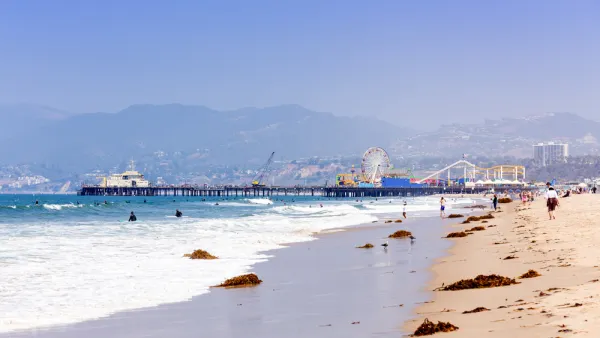
Creating Dunes to Preserve the Santa Monica Beach Against Rising Seas
The Bay Foundation have built a two acre enclave, "re-wilding" the area with native plants mimicking what it may have looked like before human interference.

Planetizen Federal Action Tracker
A weekly monitor of how Trump’s orders and actions are impacting planners and planning in America.

Washington state to charge fee to drivers with fuel-efficient cars
Revenue from the fee will go towards supporting the state’s highways.

Trump to blast ‘hydrocarbon highway’ through ‘world’s longest art gallery’
Environmental and historic preservation groups are suing to stop the project.

A data center developer is going back on its promises to nearby residents
Data center developer HostDime originally promised free at-home Wi-Fi to residents of Eatonville, Florida.

Trump administration takes another swing at Solar for All
Since the Environmental Protection Agency announced its intent to end Solar for All in August 2025, two federal judges have ruled in favor of protecting it.

The MTA wants to entice international bus manufacturers to set up shop in America
The MTA hopes to create more competition for better bus options while still "buying American."

FREE Course: Walkable City 1: Why Walkability?
After describing his path towards focusing on walkability as the essence of good planning, Jeff Speck marches through his five principal reasons for making more walkable places.
Reinventing Malls: Planning Alchemy—Turning Gray Fields Into Gold
The course focuses on the opportunities and imperatives that shape reinvention of mall sites.

City of Charlotte
City of Rosemead
Rutgers University, Edward J. Bloustein School of Planning and Public Policy
University of Michigan School for Environment and Sustainability (SEAS)
Hunter College, City University of New York (CUNY)
The Architects Foundation
University District Partnership