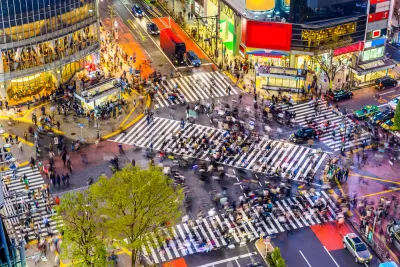
A "good news" story for pedestrians emerges from the streets of Los Angeles and Santa Monica. Traffic signals at heavily used pedestrian intersections have been reengineered to add a 'scramble phase' and the results are startling.


"We have a huge problem with pedestrian safety here in the city of Los Angeles," said Mike Bonin, chair of the City Council's transportation committee. "And so we're determined to fix that with ... Vision Zero."
NBC4's Patrick Healy reports on two new tools used by the Los Angeles Department of Transportation to give pedestrians added protection from motor vehicle turning into intersections they also would be crossing.
Motor vehicle-pedestrian crashes at the iconic Hollywood and Highland intersection have plummeted due to the introduction of a 'pedestrian scramble' (or 'scramble intersection'). Creating a separate signal for pedestrians to utilize all crossings at an intersection, thus allowing diagonal crossing to replace two crossings that are required at typical intersections is referred to as 'exclusive pedestrian phasing' by the Federal Highway Administration.
"Where 13 injury traffic accidents a year were average, there has not been a single one since a change was made last November to the traffic signal cycle, according to the Los Angeles Department of Transportation," states Healy.
In recent months, Santa Monica has converted a dozen of its downtown intersections to operate in scramble mode. Besides Hollywood and Highland, Los Angeles has another half a dozen.
Los Angeles has also changed signal timing to allow pedestrians a 'head start' so as to avoid confrontation with right and left-turning drivers who would otherwise be given the 'green light' at the same time.
In engineer speak, it's called Leading Pedestrial Interval [sic], or LPI. LA's first was installed on Broadway in 2014.
According to the National Association of City Transportation Officials (NACTO), Leading Pedestrian Intervals "have been shown to reduce pedestrian-vehicle collisions as much as 60% at treated intersections."
"It's too soon for definitive figures on safety impact, but Tim Fremaux, a transportation engineer who focuses on safety projects for the LA Department of Transportation, said there is sufficient evidence of benefits to expand LPI use," adds Healy.
Additional references:
- Accessible Pedestrian Signals: A Guide to Best Practices — Signal Phasing Considerations
- PEDSAFE: Pedestrian Signal Timing, Authored by FHWA
- Pedestrian and Bicycle Information Center: Pedestrian Signals (Funded by FHWA, maintained by the Pedestrian and Bicycle Information Center within the University of North Carolina Highway Safety Research Center.)
Related media coverage:
- KTLA5: Iconic Hollywood and Highland Intersection to Get Diagonal Crosswalk, Aug. 25, 2015
- Los Angeles Times: Tourist 'red carpet,' Hollywood and Highland, to get diagonal crosswalk, Aug. 18, 2015
- Complex Traffic Signals Make for Dangerous Intersections, August 19, 2015. [By contrast, the scramble simplifies the signals for pedestrians.]
-
LADOT Releases 'Great Streets for Los Angeles' Strategic Plan, Sets Vision Zero Goal, October 2, 2014
- A Sea of Humanity: A look at the pedestrian scramble in the Shibuya District of Tokyo, Japan, May 23, 2011
FULL STORY: Hollywood and Highland Demonstrates Pedestrian Safety Breakthrough

Los Angeles To Reduce Speed Limits on 177 Miles of Streets
The city approved speed limit reductions on close to 200 miles of city roads in an effort to reduce traffic deaths and move closer to Vision Zero.
Proposed Ballot Measure Would Require L.A. To Enforce Own Mobility Plan
The city's 2015 mobility plan was hailed as one of the nation's most ambitious, but progress toward its goals has been less than impressive.
An Investigation of the Nation's Increasing Number of Pedestrian Fatalities
PBS New Hour takes a deep dive into the climbing number of pedestrian deaths in the United States—now at their highest level in almost three decades.

Planetizen Federal Action Tracker
A weekly monitor of how Trump’s orders and actions are impacting planners and planning in America.

The state-sanctioned urbicide of Austin
People don’t kill cities. Freeways do.

US to reduce Colorado River water deliveries to Mexico
A new Colorado Treaty amendment reduces Mexico’s Colorado River water allocation by 250,000 acre feet.

5 New England states march closer to 800 megawatt wind energy project
Securing federal approval for the project may be complicated under the Trump administration, which has historically been hostile towards domestic wind power.

Baltimore to break ground on $50 million Transit Priority Project
The project will bring faster bus trips, safer streets and better bike connections to Baltimore.

Airbnb launches $250 million 'last-dollar financing' housing accelerator, makes first investment in Austin
The company will put $6.4 million towards affordable housing development in Texas’ capital.

FREE Course: Walkable City 1: Why Walkability?
After describing his path towards focusing on walkability as the essence of good planning, Jeff Speck marches through his five principal reasons for making more walkable places.
Reinventing Malls: Planning Alchemy—Turning Gray Fields Into Gold
The course focuses on the opportunities and imperatives that shape reinvention of mall sites.

Eagle County Government
Harvard University Graduate School of Design
Nashville Planning Department
The Architects Foundation
University of Cincinnati Online
The Pocatello Development Authority
The Urban Renewal Agency of the City of Pocatello
Journal of the American Planning Association