Unlike the more limited Oregon and California road usage charge programs currently in operation, Hawaii's program envisions over one million motorists participating in the demonstration program.


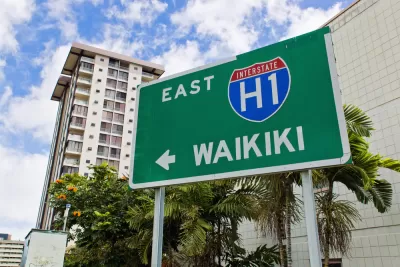
The Hawaii Department of Transportation (HDOT), in partnership with the counties of the state of Hawaii (County of Kauai, City and County of Honolulu, County of Maui, and County of Hawaii), received nearly $4 million, the largest of eight grants [see list in Sept. 6 post on the eight projects] awarded by the Federal Highway Administration on August 30 under its Surface Transportation System Funding Alternative Program.
"Although representing a small state, HDOT proposes to directly measure road use and provide prototypical billings and direct communications about the objectives of this program to over 1 million motorists across all four counties of the state," according to the 'project description' of the Hawaii Road Usage Charge Demonstration [PDF].
"The department said a tax on motor fuels now provides 33 percent of State Highway Fund revenue, but the demonstration project will test whether mileage-based fees could provide a sustainable source of funding to maintain and build Hawaii roadways," reports AASHTO Journal.
[HDOT's Highway Division] said its pilot program will build on an existing system in which Hawaii records odometer readings annually on all vehicles as part of their yearly registration inspections
Hawaii sees mileage fees, more specifically, the road usage charge (the term also used by OReGO) as a possible replacement for the gas tax because it aligns with its energy and environment goals of weaning off fossil fuels while allowing HDOT to maintain its road network."
From project description:
Transitioning Hawaii’s ground transportation vehicles from internal combustion engines to high miles per gallon (MPG) and alternative fuel vehicles is an important strategy for supporting Hawaii’s statewide energy policy goals, which include reduction or elimination of fossil fuel use. Changing the structure of transportation funding, to ensure that system maintenance and energy policy are aligned, is integral to achieving the State’s goals.
"The first demonstration activities will launch in the first half of 2017 with manual reporting and feature continuous feedback from motorists over 18 months," according to the grant application description.
HDOT is a member of the Western Road Usage Charge Consortium. Project Manager Gerald Dang has participated in WRUCC since March 2014.
Related Planetizen coverage:
-
Over $14 Million Awarded to Eight Projects to Find Alternatives to Gas Taxes, September 6, 2016
FULL STORY: Hawaii DOT Details Plans for Largest U.S. Test of Mileage-Based Road User Charge

Seven State DOTs Awarded $10 Million to Study Gas Tax Alternatives
When transportation spending was last reauthorized, rather than hike the gas tax to maintain current spending, Congress diverted general fund revenue. A program to study alternative revenue options was created so states could launch pilot projects.
Over $14 Million Awarded to Eight Projects to Find Alternatives to Gas Taxes
The U.S. Department of Transportation is funding ways to transition from the gas tax to other user-based revenue mechanisms to fund transportation infrastructure. The federal gas tax hasn't keep pace with transportation expenditures since 2008.
National Mileage Fee Pilot Program Late to Launch
EV sales are increasing–good news for the environment but bad news for road funding, as they pay no fuel taxes. Fortunately, the bipartisan infrastructure law has $125 million earmarked to "demonstrate a national motor vehicle per-mile user fee."

The state-sanctioned urbicide of Austin
People don’t kill cities. Freeways do.

US to reduce Colorado River water deliveries to Mexico
A new Colorado Treaty amendment reduces Mexico’s Colorado River water allocation by 250,000 acre feet.

New Jersey’s second-largest city bans standalone data centers
Jersey City will continue to allow co-location facilities, such as those meant for research institutions that store their own data.

Amtrak not solely to blame for New Jersey commuter rail's unreliability, report finds
A new study from the Garden State Initiative found that NJ Transit’s budget grew 20% across a 4 year period, but reliability declined significantly over the same period.

EPA erases limits on planet-warming pollution from power plants
Under Monday’s plan, power plants would still have some limits on how much mercury, arsenic and other contaminants they can emit.

Phoenix announces new on-demand transit service, more frequent RAPID buses
Both new services will launch in October, and are part of Phoenix's Project Effective Access Solutions for Easing Congestion.

FREE Course: Walkable City 1: Why Walkability?
After describing his path towards focusing on walkability as the essence of good planning, Jeff Speck marches through his five principal reasons for making more walkable places.
Reinventing Malls: Planning Alchemy—Turning Gray Fields Into Gold
The course focuses on the opportunities and imperatives that shape reinvention of mall sites.

Eagle County Government
Harvard University Graduate School of Design
Nashville Planning Department
The Architects Foundation
University of Cincinnati Online
The Pocatello Development Authority
The Urban Renewal Agency of the City of Pocatello
Journal of the American Planning Association