Cities throughout California, including Santa Monica, have been awarded research and development funding through the California Energy Commission to plan community-scale microgrid solutions.


In late 2015, the California Energy Commission released their grant funding opportunity related to building “Advanced Energy Communities” that would deploy community-scale renewable energy solutions and usher in the age of microgrids. The funding opportunity totaled $48 million, looking at assisting jurisdictions transform their energy systems with energy efficiency, renewable energy, and storage. The City of Santa Monica was one of 12 jurisdictions to be awarded a $1.5 million grant to plan and design a microgrid in Santa Monica at their City Yards location. In an exclusive interview with The Planning Report, the project leads of the City Yards Microgrid project share the vision for Santa Monica’s decarbonized, resilient energy future.
Santa Monica’s City Yards project is located in an industrial/arts district, on a landfill, adjacent to a mobile home community. The project location also includes the City of Santa Monica's facilities maintenance and resource recovery center, making it a site with significant industrial activity. Sustainability analyst Garrett Wong described how the City is using the bones of the site to “prepare to redesign and redevelop it as a facility of the future—a critical, community-facing facility…providing: renewable energy resources, local energy storage, resilience, EV charging, and good stewardship in terms of energy demand.”
As with a lot of California's energy research and development dollars, the goal of the project is understanding barriers to scalability and showing other jurisdictions what is possible in building the "2.0 electrical grid." City of Santa Monica Deputy Sustainability Officer Shannon Parry explained the importance of having Santa Monica, a smaller city with older infrastructure, as a champion of forward-looking energy systems. Parry looks at Santa Monica as a fortunate city that gets to “figure out how we can demonstrate that microgrids can be done, how they can be situated, executed, financed, and how they can work. We want this microgrid project to demonstrate that this type of innovation is feasible, and that the time to deploy distributed technologies in urban environments is now.”
The first stage of the grant is to overcome planning and permitting barriers to integrating a microgrid into existing infrastructure. These lessons, and the lessons learned by other CEC funded “advanced energy community” projects throughout the state, will be beneficial for other cities as they move forward with financing their own energy infrastructure upgrades. Santa Monica, along with the other 11 awardees of the "Advanced Energy Communities" funding opportunity, will be the guinea pigs for finding out the barriers to microgrid and clean energy technology adoption; and then address those issues so local governments can integrate clean energy solutions.
Read more about Santa Monica’s City Yards microgrid project in The Planning Report.
FULL STORY: Grid 2.0: Santa Monica Funded to Plan a Neighborhood-Scale Microgrid


AI-Powered Permitting is Speeding up Solar Deployments in California
AI-powered permitting is accelerating solar deployments in cities across California, automating compliance checks and approvals for efficient and rapid solar project installations.

A Canary in the Coal Mine for All Cities? Santa Monica City Manager Steps Down
Rick Cole discusses the existential challenges cities must grapple to be a leading city in the 21st century, Santa Monica's achievements during his five years as city manager, and the sacrifices that will be made as the city endures COVID-19.
Details of the Golden State's Residential Solar Requirement
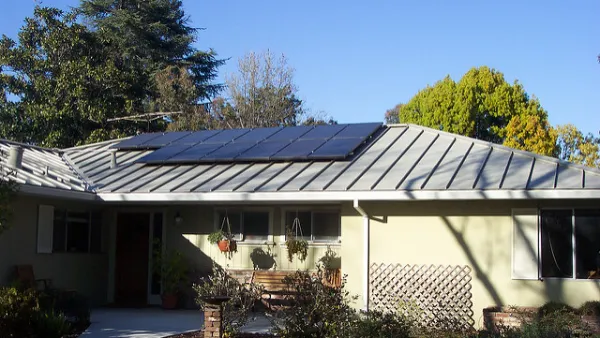
San Francisco Chronicle energy reporter David R. Baker sheds some light on the nation's first state building code requiring that solar panels be included in new home construction, adopted by the California Energy Commission on May 9.

Planetizen Federal Action Tracker
A weekly monitor of how Trump’s orders and actions are impacting planners and planning in America.

The state-sanctioned urbicide of Austin
People don’t kill cities. Freeways do.

US to reduce Colorado River water deliveries to Mexico
A new Colorado Treaty amendment reduces Mexico’s Colorado River water allocation by 250,000 acre feet.

5 New England states march closer to 800 megawatt wind energy project
Securing federal approval for the project may be complicated under the Trump administration, which has historically been hostile towards domestic wind power.

Baltimore to break ground on $50 million Transit Priority Project
The project will bring faster bus trips, safer streets and better bike connections to Baltimore.

Airbnb launches $250 million 'last-dollar financing' housing accelerator, makes first investment in Austin
The company will put $6.4 million towards affordable housing development in Texas’ capital.

FREE Course: Walkable City 1: Why Walkability?
After describing his path towards focusing on walkability as the essence of good planning, Jeff Speck marches through his five principal reasons for making more walkable places.
Reinventing Malls: Planning Alchemy—Turning Gray Fields Into Gold
The course focuses on the opportunities and imperatives that shape reinvention of mall sites.

Eagle County Government
Harvard University Graduate School of Design
Nashville Planning Department
The Architects Foundation
University of Cincinnati Online
The Pocatello Development Authority
The Urban Renewal Agency of the City of Pocatello
Journal of the American Planning Association