A new crowdsourced map projects asks people to draw their city limits from memory.


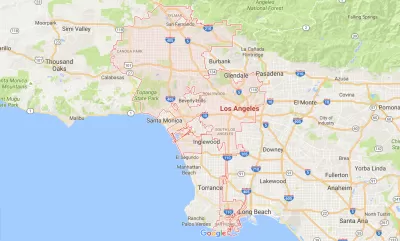
Tanvi Misra shares news of the new mapping project by Alasdair Rae, an urban scholar at the University of Sheffield, U.K., who is crowdsourcing maps of the mental boundaries of cities.
Rae's own words describe this project:
Sometimes official city boundaries extend far beyond the urban fabric, and sometimes they don't include very much of it at all. I want to see what people consider to be part of their city, or not. All the drawn boundaries on this site come from your contributions.
Yes, you can draw your own map, and, yes, you can view previous mapping attempts.
Misra notes two takeaways. First, "[f]or many, the paths they take to move around the city become its de-facto borders. M25, the highway that circles London’s core, for example, is a popular option."
Second, the "map confirms what we’ve known for a while—that how our mind recalls the space around us depends heavily on the landmarks and routes that we know and take."
Read the full story: Where Are Your City Limits?

The Gig Economy for Mapping
A new startup wants to use blockchain and the Uber model to create free, open-source maps.
CicLAvia Tour Integrates Crowdsourcing
As cyclists toured Watts and other parts of South Los Angeles, they were invited to share photographs and record places of interest along the way.
Top 10 Free Web Applications for Planning
I had the opportuntity, at the 2009 national planning conference in Minneapolis, to present (together with my colleague Christian Peralta Madera) ten free web applications that can be used to support planning. Approximately 350 participants attended the session. Since the presentation, I've received over 100 emails congratulating us on the practical nature of the presentation, and requesting links to the websites we presented. Since our presentation was a hands-on demonstration, this blog entry outlines the ten technologies, and provides links to examples of the technology in practice and resources so you can experiment with the technologies.

Planetizen Federal Action Tracker
A weekly monitor of how Trump’s orders and actions are impacting planners and planning in America.

California plans to bury El Niño’s downpour
If the state plays its cards right, it may be able to store a billion acre-feet of El Niño’s water in aquifers.

Chicago breaks ground on $3 billion megadevelopment
The new neighborhood, titled Foundry Park, will one day host 3,700 residences.

Desperate measures: Advocates weigh draining Lake Powell to fill Colorado River
Draining the reservoir could reduce evaporation losses by a couple hundred thousand acre-feet.

This road in NYC is infamously dangerous — and Mamdani can't fix it
New York City's Ocean Parkway is known for reckless driving, but the power to implement safety measures lies with the state rather than the city.

One of Denver’s busiest corridors to gain BRT
The project will span 18 miles and contain 74 bus rapid transit stations.

FREE Course: Walkable City 1: Why Walkability?
After describing his path towards focusing on walkability as the essence of good planning, Jeff Speck marches through his five principal reasons for making more walkable places.
Reinventing Malls: Planning Alchemy—Turning Gray Fields Into Gold
The course focuses on the opportunities and imperatives that shape reinvention of mall sites.

City of Rosemead
Rutgers University, Edward J. Bloustein School of Planning and Public Policy
One Hundred Miles
Hunter College, City University of New York (CUNY)
The Architects Foundation
University of Cincinnati Online
City of Cambridge
Montrose County
The Pocatello Development Authority