Joe Mathews of Zócalo Public Square views with a great deal of skepticism the urban growth boundaries the voters of Ventura County adjacent to Los Angeles County have enacted since 1995 due to the lack of infill. Another measure is on the ballot.


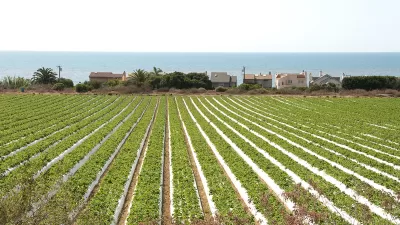
"'No other county in the United States has more effective protections against urban sprawl,' says the website of SOAR, a.k.a. Save Open Space and Agricultural Resources, a family of growth-controlling ballot measures" in Ventura County, writes Mathews in an op-ed for the San Francisco Chronicle.
Those SOAR protections have been fixed in the laws of the county and its cities for two decades. SOAR effectively permits development only within certain urban cores in the county and makes no allowances for population growth. If you want to develop protected open space or change the development boundaries, you need a vote of the people.
Smart growth strategies like SOAR are not only supposed to preserve open space. They also are supposed to drive more creative, dense, multifamily and transit-oriented development in the urban cores where growth is still permitted.
In addition to being a series of ballot initiatives, the website states that SOAR is also "a non-profit grassroots group of citizens in Ventura County, California who are dedicated to keeping Ventura County from following the same urban sprawl pattern that has plagued the rest of Southern California."
But what happens when infill doesn't accompany the urban growth boundaries that guard against unfettered development? Mathews writes that SOAR has "opposed multifamily and denser developments, and resisted transit investments to connect their cities." Consequently, residents "have enjoyed the benefits of being antigrowth — while avoiding the related responsibilities."
Mathews borrows from one of Donald Trump's famous campaign themes on immigration:
Those sprawling suburban housing developments that fill the San Fernando Valley to the east? They stop at the county’s edge. It’s almost as if Ventura County has built a wall against growth along its border — and made neighboring Los Angeles pay for it.
The results are as obvious as the choking traffic on the 101 freeway and housing prices that make Ventura County one of the country’s least affordable places. The lack of housing for middle- and lower-income people forces them to commute from outside the county, and it makes it hard for companies to grow and locate there.
Certainly Ventura County is not alone is resisting infill. Voters need not approve urban growth boundaries to fight new development, but it does give them an effective tool to stop development without accompanying incentives to promote development within the UGB boundaries.
But in its resistance to infill development, Ventura is an example of the California disease — grab your piece of the Kingdom, and keep out anyone who might come after you.
SOAR's lesson to California:
[G]rowth boundaries like SOAR shouldn’t be pursued in isolation. They need to be tied to rock-solid requirements for creating more housing in urban cores, both for low-income and middle-income people.
November ballot measures
Voters will decide on two competing measures on Nov. 8. SOAR, which backs Measure C, claims that Measure F "will allow the conversion of thousands of acres of open space and agricultural land into urban development."
According to a county document [PDF] listing local ballot measures, both measures center on agricultural, not urban development.
County of Ventura Measure “C” [italics added]
“Shall the current ordinance requiring a vote of the people for changes to Open Space, Agricultural and Rural General Plan
land use designations, goals and policies in the unincorporated area of the County be extended from 2020 through 2050,
with specified modifications, such as permitting changes without a vote to allow for up to 12 acres of land to be used for
food processing?”
County of Ventura Measure “F” [italics added]
“Shall the current ordinance requiring a vote of the people for changes to Open Space, Agricultural and Rural General Plan
land use designations, goals and policies in the unincorporated area of the County be extended from 2020 through 2036,
with specified modifications, such as permitting changes without a vote to allow for redesignation of land adjacent to certain
school sites and up to 225 acres of land to be used for food processing?”
According to a local media report, Measure F would allow farmers to use their land for non-agricultural purposes after 2036, while Measure C continues the SOAR protections to 2050.
Other posts on Mathews pieces:
- Demographic Changes and Environmental Leadership in Sacramento, September 4, 2016
Read the full story: Prevent sprawl but require denser development

Maine Law Promotes Smart Growth
New state legislation encourages cities to plan around ‘smart growth’ principles to preserve farmland and open space, and use infill development to build more housing.
Council Votes to Allow Development on the York Region's Greenbelt
The York Regional Council took a significant step toward allowing development on a large chunk of the area's greenbelt—a move opponents say will set a dangerous precedent.
Does Portland's Urban Growth Need a Course Correction?
To curb suburban "sprawl on steroids" and foster higher density infill in Portland, a shift in planning strategy is needed, according to Rick Potestio, the principal of Potestio Studio, an architecture and design firm based in the city.

Planetizen Federal Action Tracker
A weekly monitor of how Trump’s orders and actions are impacting planners and planning in America.

Amtrak, CN end decades-long dispute with eight-year agreement
The new operating agreement establishes an updated framework for the companies to work together, including processes to resolve disputes.

Northwest rail fans eager for Sept. 30 debut of Amtrak’s Airo fleet
Get ready for that new train smell and more seats. But they won’t go faster or run more frequently on the Cascades route in Washington and Oregon.

This rural Oklahoma town doesn’t want a data center. It may not be able to stop the project
With the project outside city limits and little county oversight of unincorporated land, officials are considering measures to gain local control.

Trump administration unlawfully slashed $7 billion in clean energy grants, judge rules
The Environmental Protection Agency ended the Solar For All program, which provided the grants, after President Donald Trump’s inauguration.

Record-breaking wildlife overpass in Colorado brings 91% reduction in animal collisions
Prior to the overpass, vehicles were hitting one deer per day on Colorado’s Interstate 25.

FREE Course: Walkable City 1: Why Walkability?
After describing his path towards focusing on walkability as the essence of good planning, Jeff Speck marches through his five principal reasons for making more walkable places.
Reinventing Malls: Planning Alchemy—Turning Gray Fields Into Gold
The course focuses on the opportunities and imperatives that shape reinvention of mall sites.

City of Thousand Oaks
City of Wisconsin Rapids
Harvard University Graduate School of Design
The Architects Foundation
University of Cincinnati Online
The Pocatello Development Authority
The Urban Renewal Agency of the City of Pocatello