A median-income family in the L.A. metro area spends 73 percent of their income on housing and transportation alone. L.A. Metro explains why and how they're taking huge steps to get affordable housing on land they own—where it will do the most good.


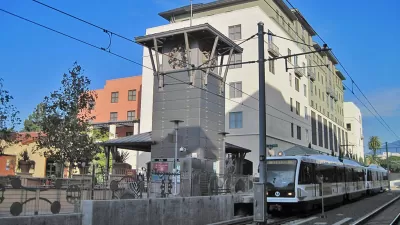
Across the country, inequity is a defining issue of our time, and in Los Angeles and the San Francisco Bay area, the examples are stark. According to the Brookings Institution, the San Francisco metro area ranks third and Los Angeles metro area seventh as areas with the highest income inequality in the country. Stagnant and low wages and increased poverty and homelessness are but a few of the alarming trends that wealth disparity has brought to these regions.
Los Angeles and the San Francisco Bay Area also top the charts for the highest rent and home sale prices, and no one feels this pinch more than low-income families and low-wage workers. According to the National Low Income Housing Coalition, a California worker needs to earn $28.59/hour to afford a two-bedroom apartment, ranking third in the nation for the highest housing wage. A median-income family in the Bay Area spends 62 percent of their income on housing and transportation alone, and in Los Angeles metro area that percentage is higher: 73 percent. Longtime residents in these regions can no longer afford to stay in their homes. As the trend of urban displacement and gentrification continues, the suburbanization of poverty forces low-income workers to endure long commutes on the freeway, leading to increased pollution and greenhouse gas (GHG) emissions.
In 2006, California enacted landmark legislation to reduce GHG emissions with the Global Warming Solutions Act of 2006 (AB 32), which set GHG emission reduction goals into law. Accompanying AB 32, the Sustainable Communities and Climate Protection Act of 2008 (SB375), supports the State's climate goals of GHG emissions reduction by coordinating, for the first time ever, transportation and land use planning to foster sustainable communities. These laws laid the foundation for the creation of California’s multi-billion dollar cap-and-trade program now referred to as the California Climate Investments Program (CCIP, formerly the Greenhouse Gas Reduction Fund) for which cap-and-trade proceeds support three main program areas: Transportation and Sustainable Communities, Clean Energy and Energy Efficiency, and Natural Resources and Waste Diversion.
With the state mandating land use and transportation planning coordination through the Sustainable Communities Strategy (SCS) and providing resources for programming and projects through CCIP, regional and local public agencies throughout the state, such as transit operators, are adopting the new framework of equity and sustainability by creating their own policies, programs, and projects.
The Role of Transit Operators in Affordable Housing Development
Among the largest transit operators in California, Metro, BART, and VTA began steps toward building a framework of equity and sustainability through their affordable housing policies. Metro has an operations budget of $1.6 billion, serving Los Angeles County with 4,000 buses that carry 1.6 million passengers daily, and 300 miles of rail transporting 340,000 riders daily. BART spans 5 of the 9 counties in the Bay Area with 430,000 daily weekday riders with 45 stations and 104 track miles and a budget of approximately $2 billion. As the primary transit operator of Silicon Valley, VTA buses and rail serve 44 million riders annually with a budget of $510 million.
All three transit operators own significant land holdings for joint development, which has emerged as one of the most precious public resources in high-cost regions. The dissolution of redevelopment agencies under the Brown administration not only slashed $1 billion for affordable housing, it also significantly shifted the landscape of public sector capacity to plan, finance, and acquire sites for affordable housing and other community amenities like parks and plazas. For affordable housing developers, land owned by transit operators is particularly valuable because affordable housing developers are not competing on the speculative market to acquire these sites, and transit operators are patient land owners as the financing comes together for an affordable housing development.
Making the Case for Transit-Oriented Development (TOD): Increased Ridership
For transit operators, ensuring ridership is critical to a functioning transit system, and recent studies demonstrate that affordable TOD has a larger ridership bonus than market-rate TOD, and the development and preservation of affordable housing near transit is a critical strategy for expanding transit ridership.
A 2014 study by TransForm and the California Housing Partnership Corporation found that lower income households drive 25 to 30 percent fewer miles when living within a half-mile of transit than those living in non-TOD.
FULL STORY: Four Awesome Ways LA Metro Is Increasing Affordable Housing

San Diego wants to limit upzoning law to just 16% of transit-adjacent parcels
The city's planning director says some areas are unfit for immediate upzoning due to a lack of resources or hazards such as wildfire risk.
LA Delays State TOD Law to 2030 With its Own, Lower-density Plan
SB 79 allows cities to delay its implementation if they come up with alternate plans to boost density while retaining local control near transit.
Report: MBTA Communities Act has Created Just 7,000 New Housing Units
The Massachusetts law requires cities to rezone appropriate neighborhoods for denser housing.

The state-sanctioned urbicide of Austin
People don’t kill cities. Freeways do.

US to reduce Colorado River water deliveries to Mexico
A new Colorado Treaty amendment reduces Mexico’s Colorado River water allocation by 250,000 acre feet.

New Jersey’s second-largest city bans standalone data centers
Jersey City will continue to allow co-location facilities, such as those meant for research institutions that store their own data.

Amtrak not solely to blame for New Jersey commuter rail's unreliability, report finds
A new study from the Garden State Initiative found that NJ Transit’s budget grew 20% across a 4 year period, but reliability declined significantly over the same period.

EPA erases limits on planet-warming pollution from power plants
Under Monday’s plan, power plants would still have some limits on how much mercury, arsenic and other contaminants they can emit.

Phoenix announces new on-demand transit service, more frequent RAPID buses
Both new services will launch in October, and are part of Phoenix's Project Effective Access Solutions for Easing Congestion.

FREE Course: Walkable City 1: Why Walkability?
After describing his path towards focusing on walkability as the essence of good planning, Jeff Speck marches through his five principal reasons for making more walkable places.
Reinventing Malls: Planning Alchemy—Turning Gray Fields Into Gold
The course focuses on the opportunities and imperatives that shape reinvention of mall sites.


Eagle County Government
Harvard University Graduate School of Design
Nashville Planning Department
The Architects Foundation
University of Cincinnati Online
The Pocatello Development Authority
The Urban Renewal Agency of the City of Pocatello
Journal of the American Planning Association